

Recently, a research team from the Joint Laboratory of High Power Laser Physics, Shanghai Institute of Optical Precision and Mechanical Research, Chinese Academy of Sciences (SIPM), has analyzed the amplitude-frequency modulation (FM-to-AM) of the whole link of Shenguang II upgrading device. The results are summarized as "Theoretical analysis of frequency modulation-to-amplitude modulation on the final optics and target The theoretical analysis of frequency modulation-to-amplitude modulation on the final optics and target of the SG II-Up laser facility" was published in High Power Laser Science and Engineering.
In optimizing the laser-target interaction in inertial confinement fusion, it is required that each laser beam has good control of the time-power curve and the uniformity of the target surface. And amplitude-frequency modulation (FM-to-AM) is an important factor affecting the time-power profile of high-power laser devices. In high power laser drivers, in order to avoid the stimulated Brillouin scattering (SBS) effect of large aperture optics and to achieve a smoother target surface intensity distribution, a spectrum broadening technique based on sinusoidal phase modulation is required in the front-end system. Ideally, pure phase modulation does not affect the temporal characteristics, however, when FM lasers are transmitted with a non-uniform transfer function, frequency modulation is converted to amplitude modulation. For high power laser drivers, the sources of amplitude-frequency modulation generation are varied. Suppression of the FM-to-AM conversion is critical because time-power profile control affects the optimal laser-target interaction and because the intensity peaks generated by amplitude modulation can damage the optics and affect the performance of the laser. At present, the NIF device in the United States, the LMJ device in France, and the Shenguang series of devices in China have carried out a series of research work on the suppression of FM-to-AM.
The researchers have adopted the all-single-polarization front-end system based on single-polarization transmission fiber and grating-based group velocity dispersion compensation unit to solve the amplitude-frequency modulation caused by polarization mode dispersion and group velocity dispersion, and at the same time, they have developed the full-spectrum segment fidelity amplification technology, solved the gain narrowing problem of the amplification system, and achieved the fundamental frequency time-domain modulation regime of less than 5% @ 0.3 nm (3G + 20G).
On the basis of this work, the researchers further carried out an evaluation study of the amplitude-frequency modulation at the nanosecond terminal and target surfaces, and the results showed that the modulation regime at the incident surface of the wedge-shaped target mirror (WFL) was 19%, while the modulation regime at the target surface was 4.9% due to the combination of dispersive grating and focusing system. It is worth noting that 50% of the modulation regime comes from the high-frequency 20 GHz. In addition, the dispersive grating used in the spectral dispersion smoothing stage introduces a time delay, and the combined effect of the dispersive grating and the focusing lens is equivalent to a Gaussian low-pass filter at 8 GHz (3 dB bandwidth), where the transmittance of the spectral component at 20 GHz is less than 15%, and the high-frequency component is filtered out significantly, realizing the reduction of modulation regime to 5.0% on the target surface. The modulation regime on the target surface is reduced to less than 5%.
This work provides an important basis for monitoring the amplitude-frequency modulation during the operation of ICF high-power laser driver, evaluating the loading capacity of terminal optical components, and assessing the laser-target interaction.
This work is supported by the Strategic Priority Research Program of the Chinese Academy of Sciences.
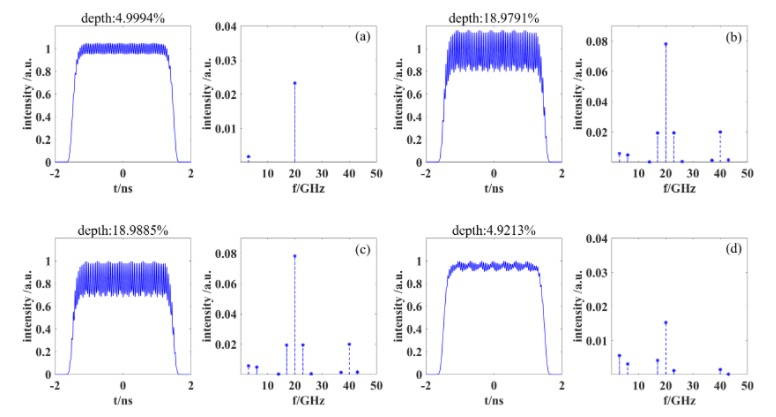
Figure 1: Amplitude-frequency modulation and corresponding intensity spectral distributions on (a) the main amplifier, (b) the WFL incident plane, (c) the beam sampling grating, and (d) the target plane under 3G + 20G dual-frequency phase modulation.

Figure 2: (a) Time-domain modulation before (blue) and after (red) the wedge target mirror; (b) AM spectral transfer function

Apr 19, 2024
Leave a message
Shanghai Institute Of Optics And Precision Machinery (SIPM) Makes New Progress in ICF High Power Laser Driver Amplitude-frequency Modulation (FM-to-AM) Research
Send Inquiry


