


Recently, a team of researcher Yang Shanglu from Shanghai Institute of Optics and Precision Machinery (SIPM), Chinese Academy of Sciences (CAS), R&D Center of Laser Intelligent Manufacturing Technology, has made new progress in laser welding of new structural materials for high-temperature molten salts. For the first time, the team has realized defect-free welding of nickel-based high-temperature alloys using a high-power laser, and systematically evaluated the microstructure and mechanical properties of the welded joints. The research results were published in the journal "Laser welding of GH3539 alloy for molten salt reactor: processing optimization, microstructure and mechanical properties". The research results were published in Materials Characterization under the title of "Laser welding of GH3539 alloy for molten salt reactor: processing optimization, microstructure and mechanical properties".
GH3539 alloy is a new type of high-temperature nickel-based alloy independently developed by China, which has excellent high-temperature mechanical and corrosion-resistant properties, and is suitable for ultra-high-temperature (≥850°C) molten salt environment. However, the higher alloying results in the alloy having a higher sensitivity to weld cracking. In order to achieve high efficiency and high quality laser welding of alloy structural components, the team used fiber laser welding technology to study the effect of different welding process parameters on the welding of 3mm plate thickness GH3539 alloy, through process optimization to inhibit the generation of weld cracks, porosity and other defects, for the first time to achieve the GH3539 alloy flawless weld shaping, on the basis of which the welded joints of the microstructure and room temperature / high temperature On this basis, the microstructure and room temperature/high temperature mechanical properties of the welded joints were systematically evaluated; and the tensile fracture behavior of the laser-welded joints was analyzed, which elucidated the fracture mode of the laser-welded joints. This work lays a foundation for promoting the development of laser welding technology of GH3539 nickel-based high-temperature alloy and the application of the alloy.
This work was supported by the Youth Fund of the National Natural Science Foundation of China and the National Key Research and Development Program of China.
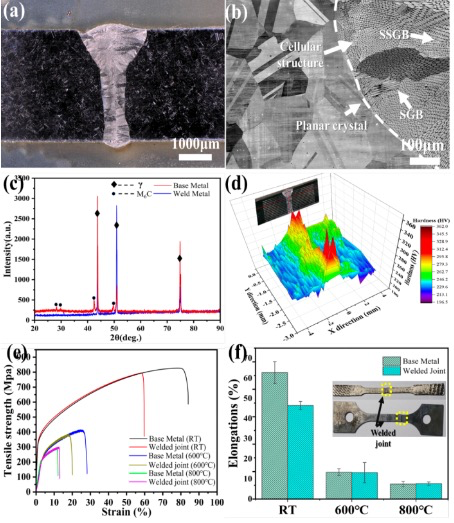
Figure 1: (a) Welded cross-section of GH3539 laser welded joints; (b) Microstructure of GH3539 alloy; (c) XRD results of GH3539 alloy laser welded joints; (d) Hardness distribution of GH3539 alloy laser welded joints; (e) Engineering stress-strain curves of the base material and welded joints at different temperatures; (f) Average stress-strain curves of the base material and welded joints at different temperatures. (f) Average elongation of base material and welded joints at different temperatures.


