

Terahertz waves are valuable in communication and imaging applications. The nonlinear interaction of strong-field ultrafast lasers with matter is one of the important ways to generate terahertz waves. Experimental and theoretical studies related to terahertz-generating media such as plasma, gas, and crystals are relatively well studied. However, liquid water, which is a very strong absorbing medium for terahertz waves, has not been reported to generate terahertz waves.In 2017, it was experimentally found that terahertz waves are more radiated than absorbed when the liquid film thickness or the liquid beam diameter is reduced to the micrometer scale. This opened up a new direction in liquid terahertz wave research.
In recent years, there have been experimental reports in the field of liquid terahertz waves, but more phenomena observed experimentally are different from the results of other media. For example: a monochromatic laser field can effectively generate liquid terahertz waves, while the gas medium requires a specific phase difference of the two-color laser; the yield of the liquid terahertz wave is proportional to the energy of the driving laser, while in the gas medium is a square relationship; in a certain range of the liquid terahertz wave yield with the increase of the pulse width of the laser increases, while the opposite is true of the gas medium; in the two-color laser drive, the liquid terahertz wave A non-modulated signal appears in the liquid terahertz wave driven by a two-color laser, while no similar signal is seen in the gas medium. The theoretical study of complex and disordered liquid-phase systems has always been a difficult problem, and the above phenomena are difficult to be explained by existing theories. Researchers can only explain some macroscopic experimental results at high light intensity based on previous plasma models and interface effects.
Recently, Bian Xuebin, a researcher at the Institute of Precision Measurement Science and Technological Innovation (IPMSI) of the Chinese Academy of Sciences (CAS), and Li Zhengliang, a doctoral student, proposed a displacement current model for generating liquid terahertz waves, which can systematically explain the series of anomalies observed in the above experiments. The physical image of the microscopic mechanism model is shown in the figure: the disordered structure of the liquid makes the electron wave packet localized, while the energy of the outer electrons of different molecules is shifted by the environment, and the outer electrons of different molecules under the action of the strong-field laser undergo a jump to generate displacement currents in the asymmetric system. The energy difference of these leaps is in the terahertz energy region, which in turn radiates terahertz waves. At the same time, this work shows that the quantum effect of the atomic nucleus plays a key role, and predicts that terahertz radiation can study the isotope effect of liquids.
The above results are another theoretical progress of Xuebin Bian's team in the field of liquid-phase strong-field ultrafast dynamics research, following the high-harmonic statistical rise and fall model. The related research results were published in the Proceedings of the National Academy of Sciences of the United States of America (PNAS) under the title of Terahertz radiation induced by shift currents in liquids. The research work was supported by the National Key Research and Development Program of China, the National Natural Science Foundation of China, and the Program for Stable Support of Young Teams in Basic Research Areas of the Chinese Academy of Sciences.
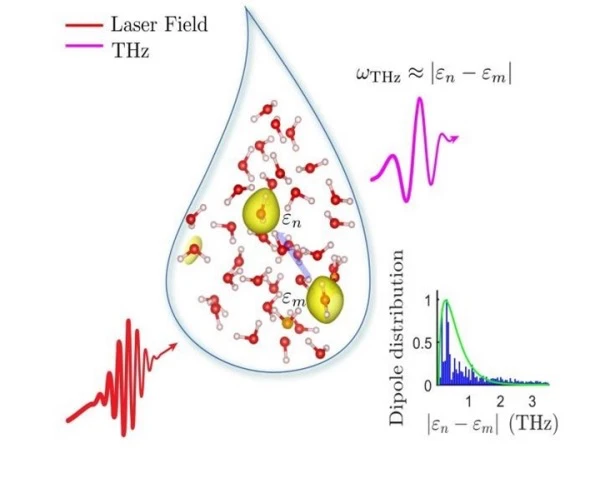
Schematic diagram of liquid terahertz wave generation

Mar 22, 2024
Leave a message
Precision Measurement Institute Advances in Theoretical Study Of Liquid Terahertz Wave Generation Mechanisms
Send Inquiry


