


The world of martial arts, only fast.
Sometimes, we will put a very short time, described as "the time of a heartbeat", and the duration of a heartbeat is 10 to the 18th power of a second.
In a recent experiment similar to stop-motion photography, a team of scientists from the United States and Germany captured for the first time "freeze frames" of electrons moving in liquid water in real time, and the results were published in the journal Science.
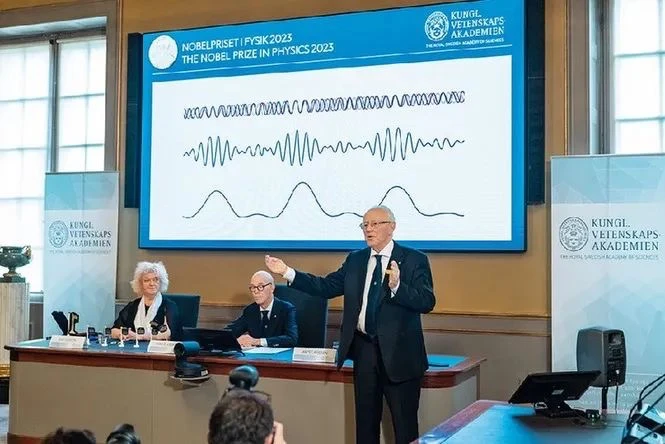
Experts from the jury explain the research results of the 2023 Nobel Prize in Physics winners at the announcement of the 2023 Nobel Prize in Physics in Stockholm, Sweden, Oct. 3, 2023
According to the experts, the result marks a major advance in experimental physics, providing a window into the electronic structure of molecules in liquids on time scales previously unattainable with X-rays. Previously, scientists were only able to resolve electron motion on the picosecond (1 second = 1 trillion picoseconds) time scale. Now, the ability to study the electronic reactions of X-rays hitting a target on the attosecond scale allows researchers to delve into radiation-induced chemical reactions a million times faster than previous methods.
All indications are that the attosecond laser may be the key to unlocking the mysterious world of electronics.
What is an "attosecond"?
For ordinary people, the attosecond is an extremely strange concept.
In fact, as early as in the Warring States period, China's famous thinker, the corpse Kao put forward "four sides up and down said Yu, ancient and modern said Zeus," the simple view of space and time. To this day, at the forefront of physics research, space and time are still the most important and fundamental two dimensions.
As far as human senses are concerned, when an object is in rapid motion, its images are blurred and overlapped, and changes occurring in a very short period of time cannot be observed. It is therefore important for scientists to develop more precise "windows of time" to capture or depict these very brief moments.
In the 19th century, there was a much talked about and debated question in physics: when a horse runs, do all four legs leave the ground at the same time?
The American entrepreneur Leland Stanford was very interested in this question. In order to verify this conjecture, he approached the famous photographer Edvard Muybridge. In those days, the video function had not yet been born, when the response time of the camera shutter was 15 seconds, sometimes even up to a minute.
Horses would not slow down to take care of the camera shutter, and their clattering hooves were the biggest obstacle to verifying this hypothesis. Edvard Maibridge did not give up so easily, he had the bright idea, not only to improve the camera shutter design, but also placed 12 cameras and mechanisms on the runway. Whenever the horse approached the camera, the mechanism would be triggered and a photo would be taken. In the end, he put the 12 photos together, which is the whole process of the horse running.
By looking at the spliced photos, people soon found the answer to the question: when a horse runs, it can indeed capture a moment - its four legs leave the ground at the same time.
On October 3, 2023, the Royal Swedish Academy of Sciences announced that it had awarded that year's Nobel Prize in Physics to Pierre Agostini, Ferenc Krauss, and Anne Lhuillier for their "experimental method for generating attosecond light pulses for the study of the dynamics of electrons in matter."
"We can now open the door to the world of electrons. Attosecond physics has given us the opportunity to understand the mechanisms of electronic control. The next step will be to exploit them." So says Eva Olson, chair of the Nobel Committee for Physics.
When scientists plunged their perspective into the world of electrons, they discovered that the rate of change in position and energy varies between one and several hundred attoseconds, where one attosecond is one billionth of a second. The technology of attosecond pulsed light is the fastest time scale currently available to mankind, and it is like a ruler, the finer the scale of the ruler, the higher the precision of the measurable.
Yuan Lanfeng, deputy director of the Department of Science and Technology Communication, School of Humanities and Social Sciences, University of Science and Technology of China, said that the attosecond light pulse can be understood as the principle of high-speed camera, and that a camera with a fast reaction speed is needed to capture the wonderful moments of a person's movement process. The attosecond light pulse is the "high-speed camera" in microscopic reaction research.
In the past, the time limit for laser pulses was "femtoseconds", which was enough for people to see atoms, but for electrons, the time resolution of "femtoseconds" was so coarse that, according to this scale, one could only obtain a mosaic-like effect. The Coherent Light Pulses Progress from Femtoseconds
The progress of coherent light pulses from femtoseconds to attoseconds is not only a simple progress in time scale, but more importantly, it advances people's ability to study the structure of matter from the motion of atoms and molecules to the inside of atoms, where they can probe the motion and correlation behaviors of electrons, which will lead to a major revolution in basic physics research.
What will the attosecond bring to ordinary people?
One day in 1999, Ahmed Xavier, a professor at the California Institute of Technology, won the Nobel Prize in Chemistry for his discovery. Xavier's research in the 1980s, using a laser beam to film the oscillations of atoms in the transition state, helped scientists to observe atoms and molecules in the process of chemical reactions in "slow motion", and thus to study the nature and structure of the transition state. For this reason, Xavier is also known as the "father of femtosecond chemistry".
Since then, scientists have come to realize that lasers, like lightning, can capture those fleeting moments. This discovery provided the theoretical basis for a series of disruptive studies.
Today, the speed of this laser has been upgraded by a thousand times, successfully realizing the drastic change from femtoseconds to attoseconds.
Nowadays, when people mention femtosecond laser, they can often think of the many applications represented by femtosecond laser myopia surgery. And when it comes to attosecond laser, it seems difficult to connect this term with the productive life of ordinary people.
Yuan Lanfeng frankly said, "the a-second laser is not much use at present, its application has just begun, and it is still all stuck in basic research." However, this does not mean that the attosecond light pulse has no application potential, "it opens a door, but what is behind this door still needs us to explore in depth." He said.
So what's behind that door?
Pulsed-field ablation system photographed at the Medtronic booth in the Medical Devices and Healthcare section of the 6th Fair on November 5, 2023
"Electron motion is responsible for generating light as well as the formation and breaking of chemical bonds that change the structure of biomolecules and their function in living systems, and for processing information as fast as possible ...... Today, we are using attosecond light pulses to better understand microscopic involving electrons, atoms, and molecules processes and find out how they affect the macroscopic world." Earlier, after winning the Wolf Prize in Physics, Ferenc Krauss stated the value of the applications of attosecond physics in this way.
Eva Olson, on the other hand, said that attosecond physics gives us the opportunity to understand the mechanisms of electronic control, paving the way for potential applications in the electronic information industry and medicine.
Wei Zhiyi, a researcher at the Institute of Physics of the Chinese Academy of Sciences, believes that the technology can be combined with superconductivity, nanomaterials, photovoltaic industry, pharmaceuticals, laser medicine and other fields to promote a more in-depth understanding of the structure of matter by mankind, which will lead to relevant revolutionary advances.
Undoubtedly, although the current application of attosecond physics is still a distance from some people's imagination, it has an extremely wide range of application scenarios.
It provides mankind with a pair of "intelligent eyes" to study the microscopic world.
With its support, many microscopic processes will no longer require "circumstantial evidence" to be confirmed, but can be directly observed: the attosecond laser can be used to photograph a variety of high-speed motion processes, such as chemical reactions, molecular-scale motion and atomic-scale motion.
Photographing chemical reactions with attosecond lasers can help scientists better understand reaction mechanisms and further improve chemical processes. Photographing the motions of molecules and atoms with attosecond lasers can reveal their interactions and kinetic processes, which are important for research in materials science and bioscience.
In the field of biomedicine, for example, the high-resolution imaging technology of attosecond pulses is expected to enhance the early diagnosis and treatment of diseases, and provide new breakthroughs for the study of cancer, neurological diseases and other major medical challenges.
It is understood that the Ferenc Krauss team is also trying to use femtosecond and attosecond techniques to analyze blood samples and detect small changes in them. They are analyzing whether these changes are specific enough to be able to clearly diagnose the disease at the initial stage of the disease, this technology may have a significant impact on the study of cancer and other difficult diseases.
The acceleration of the "attosecond era"?
In 2021, Science magazine published "125 of the world's most cutting-edge scientific problems", of which more than 10 need to be solved by ultrafast science. The emergence of attosecond pulses is expected to lead to more original innovations in several fields of scientific and applied research.
The attosecond laser, not a gift of nature, but a man-made miracle.
French physicist Anne Lhuillier was the first to discover the tools to pry open the world of attoseconds. in 1987, she was doing gas ionization experiments, the wavelength of 1064 nanometers of laser light into argon and several other rare gases, the gas appeared to be a different color from previous experiments.
She then published a key paper, discovering the phenomenon of high harmonics generated by strong laser irradiation of noble gases, and obtained the typical spectral structure of high harmonics, the spectral width of which has been able to support pulses on the order of attoseconds, providing the prerequisite conditions for the breakthrough of laser pulses to attoseconds. Since then, her research career and attosecond lasers have been closely intertwined, and 16 years later, she led a team of researchers to set a world record for the shortest laser pulse of 170 attoseconds.
The two other scientists who won the Nobel Prize in Physics together with her have also added to the "attosecond building": Hungarian Ferenc Kraus led a team of researchers to create and measure the first attosecond light pulse in 2001, and used it to capture the movement of electrons inside atoms, marking the birth of attosecond physics. In addition, his team managed to isolate pulses lasting 650 attoseconds, the first time scientists have successfully tracked the detachment of electrons from atoms. Frenchman Pierre Agostini, a leader in the interaction of strong-field lasers with atoms, and his team pioneered attosecond physics by generating and measuring attosecond light pulses for the first time and using them to capture the motion of electrons inside atoms.
Today, more scientists are competing for the top spot in the field in many parts of the world.
In the laboratory, the fruitful results are frequent: in 2022, researchers from the University of Michigan and the University of Regensburg in Germany collaborated to capture the motion of electrons within a few hundred attoseconds, the fastest speed so far.
In the same year, a team of researchers from the Center for Advanced Photonics at the RIKEN Institute of Science and Chemistry in Japan and the University of Tokyo collaborated to develop a new type of interferometer for dealing with fringes arising from optical interference originating from attosecond pulses and quantum interference with electronic states in matter. They demonstrated the feasibility of the interferometer scheme by post-generative splitting of high harmonic pulses through experiments using samples of helium atoms.
In addition, international construction and competition for an attosecond laser facility has begun. Advocated by Nobel Prize-winning physicist Gérard Mourou and others, the European Union has taken the lead in Hungary in the construction of the European Extreme Light Facility-Altosecond Light Source (ELI-ALPS), and has promoted the construction of internationally renowned companies such as Fastlite, Active Fiber, and Light Conversion. Laser technology companies such as Fastlite, Active Fiber, Light Conversion and other internationally renowned product iteration and upgrading, these new-generation laser technology will play an important role in advanced manufacturing, national defense science and technology and other fields.
In China, relevant scientific research units are carrying out infrastructure construction of attosecond light sources on a large scale, such as the Institute of Physics of the Chinese Academy of Sciences and the Songshan Lake Materials Laboratory in Dongguan, Guangdong Province, Songshan Lake to build the attosecond science center. It is understood that after the completion of this center is expected to achieve the international leading comprehensive indicators.


