


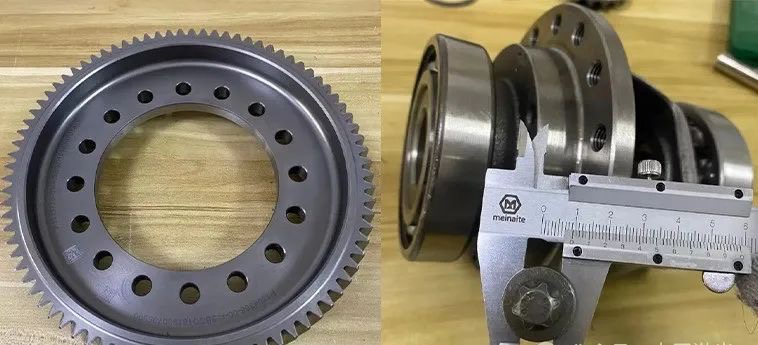
Differential is an important part inside the automobile reducer assembly, whether it is a traditional passenger car or a new energy passenger car, it can provide power transmission and guarantee the smooth operation of the left and right wheels of the car turning. Differential is mainly assembled by differential case and passive pot gears and some bearing planetary gears. At present, most of the differential cases and passive pot gears are connected by bolts, and this traditional connection has many processing procedures, large quality and high cost, which is not in line with the development trend of the automobile industry.
Laser welded differentials have four major advantages
First, 15% weight reduction of differential, more compact structure
Since the traditional differential shell and basin gear are connected by bolts, it is necessary to process certain depth threaded holes, and the wall thickness of the parts in the threaded position is designed to be thicker, so the quality of the assembled assembly is generally larger. Welded differentials do not have connecting bolts, eliminating the need to machine threaded holes in the parts, and can also be designed to thin and reduce the weight of the thicker parts of the differential case and basin gears, reducing the overall quality by about 15%. In addition, the welded differential does not need to reserve space for assembly of bolts, and the weld position can be set on the outer side of the differential, so the overall size of the reducer can be smaller, especially suitable for new energy vehicles with three-in-one electric drive system on the installation of parts integration requirements.
Second, reduce differential material and installation cost by 20%.
After the differential and main reduction gear are connected by welding, first of all, it saves a lot of expensive cost of bolts. Take a new energy vehicle differential for example, the differential is linked with 16 M10 bolts. At the same time canceled the differential and the main reduction gear bolt holes, threaded holes and other processes, saving the drilling and tapping and other processing costs, canceled the assembly assembly process, saving the assembly and other labor costs and bolt tightening equipment costs. The only relative increase is in laser welding costs, which are about 20% lower than the cost of bolted differentials under fully automated conditions in the batch.
Third, laser welded main reduction gears for differentials increase precision by 2 grades.
The main reduction gear of the welded differential and the differential are ground as an integral part after welding, and the precision after grinding is the actual use precision without assembly error. The grinding of the main reduction gear of the bolted differential can stably reach grade 5 gear precision, and after assembly and bolt tightening, the gear precision is grade 6 to 7 precision. The main reduction gear of mass-produced welded differential can stably reach 4 to 5 levels of accuracy without assembly error, and the welded differential has obvious advantages in terms of gear accuracy.
Fourth, NVH test gear noise reduced by 2dB
Due to the improved precision of the welded differential gears, the gear noise is significantly reduced when assembled into the gearbox for NVH test, and the noise is reduced by 2 dB compared with the bolted differential gearbox, especially for new energy vehicles with high requirements on NVH, so the advantage is even more obvious.

DgeLaser is a well-known high-end laser equipment and intelligent manufacturing solutions provider, the company has long been focusing on automotive lightweight laser equipment solutions, including automotive transmission gear laser welding production line DgeLaser WG series products have manual line, semi-automatic line, automatic line, can meet the demand for high-precision welding of symmetrical rotary parts, such as differential, hollow shafts, intermediate shafts, clutches, gear shafts, etc. and different production capacity. and different production capacities. Each production line has gone through multiple production processes before and after welding, such as laser cleaning, heating, press fitting, end run inspection, laser welding, ultrasonic flaw detection, which can effectively control the generation of weld porosity and cracks and ensure the quality of weld seams, and the qualification rate of the line can reach more than 98%.


