


In the scientific community, the mid-infrared band is renowned as the "molecular fingerprint region," where the characteristic vibrational and rotational energy level transitions of most gas pollutants and biomolecules are concentrated. Spectroscopic detection equipment built upon QCLs serves as the core hardware for environmental remote sensing, industrial gas monitoring, non-invasive medical diagnostics, and high-speed free-space optical communications. However, traditional mid-infrared QCLs have long faced multiple technological barriers. Mainstream low-power solutions heavily rely on complex semi-insulating InP (SI-InP) lateral regrowth processes, which not only involve cumbersome manufacturing and low chip yields but also significantly drive up overall costs. Additionally, these devices generally suffer from limited heat dissipation and persistently high power consumption, making them difficult to adapt to the demands of portable and miniaturized field detection equipment.
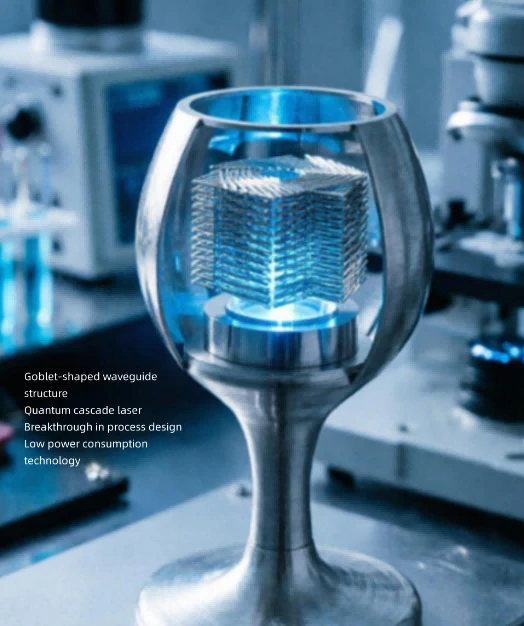
To address these industry pain points, Researcher Meng Bo's team at CIOMP charted a new course by innovatively proposing the "Goblet-shaped" waveguide QCL. The core design concept involves selectively wet-etching the active region so that its width is significantly smaller than that of the upper and lower cladding layers, forming a unique goblet-like cross-sectional profile. This integrated design simultaneously resolves bottlenecks in manufacturing, current injection, and thermal management. First, it completely eliminates the need for the SI-InP lateral regrowth process, drastically lowering the threshold for mass production and manufacturing costs. Second, the retained wide upper cladding structure ensures uniform current injection, preventing localized current crowding. Finally, the extended InP cladding creates multiple heat dissipation pathways, effectively mitigating the thermal resistance bottleneck caused by traditional SiO₂ passivation layers and fundamentally improving the high-temperature operational stability of the lasers.
To verify the feasibility of this design, the research team fabricated over 50 goblet-shaped QCL devices of varying sizes and conducted systematic evaluations. Multiple key indicators reached advanced levels among similar structures. Under room temperature (293 K) conditions, a 1 mm × 3 μm device achieved a continuous-wave (CW) threshold power consumption of approximately 1 W, with a pulsed threshold power consumption as low as 0.85 W. The room-temperature CW output power exceeded 27 mW, while at a low temperature of 243 K, the maximum CW output power reached 83 mW, and the pulsed output power increased to 130 mW. Furthermore, the device demonstrated excellent optoelectronic conversion performance, achieving a room-temperature pulsed wall-plug efficiency (WPE) of 3.9%, with comprehensive performance matching mainstream buried heterostructure products. In terms of reliability, during a 25-hour uninterrupted high-power operation test, the output power fluctuation was merely 1.9 mW, fully validating the structure's exceptional thermal stability and robustness.

Notably, the narrowest 2 μm-wide devices achieved stable single-mode lasing across the entire dynamic current range, with a side-mode suppression ratio of approximately 20 dB, requiring no wavelength-selective elements. This single-frequency characteristic offers new insights for integrating single-frequency mid-infrared light sources on-chip. Historically, high-performance mid-infrared laser chips have been heavily dependent on overseas products. This technological breakthrough balances process simplicity, low power consumption, and high reliability, providing an autonomous technological route with strong industrialization potential. Looking ahead, this light source solution is expected to significantly accelerate the localized iteration of handheld gas detectors, vehicle-mounted environmental monitoring equipment, and portable medical spectrometers, while also empowering cutting-edge fields such as on-chip nonlinear photonics and atmospheric trace gas remote sensing.


