


Recently, the team of Professor David Di from the School of Optoelectronic Science and Engineering of Zhejiang University/Haining International Joint College, Researcher Zou Chen and Professor Zhao Baodan developed the world's first electrically driven perovskite laser. This is a "dual-cavity" laser containing two optical microcavities. It integrates a low-threshold perovskite single-crystal microcavity subunit and a high-power microcavity perovskite LED subunit into the same device, forming a vertically stacked multi-layer structure.
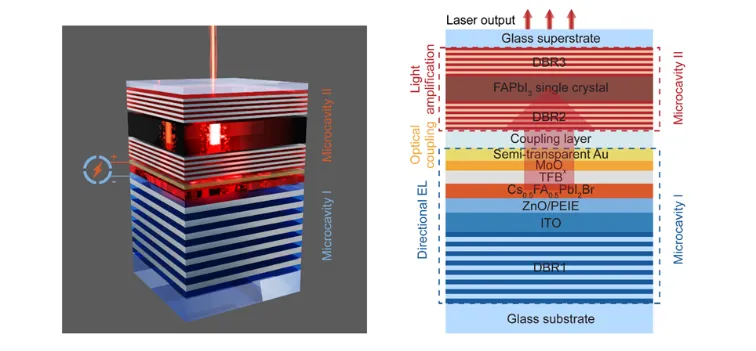
This novel semiconductor laser requires a minimum current (threshold current) of 92 A/cm² to emit light, which is one order of magnitude lower than that of the best organic semiconductor lasers. It also exhibits excellent stability and enables rapid modulation at a bandwidth of 36.2 MHz, making it a promising candidate for applications in on-chip data transmission, computing, and biomedicine. The research paper was published in *Nature* on August 27.
There are numerous types of lasers, and currently, novel laser materials such as perovskite semiconductors, organic semiconductors, and quantum dots are demonstrating significant advantages. Among these materials, perovskite semiconductors hold exceptional technical promise due to their tunable emission spectra (capable of producing various colors) and extremely low laser emission thresholds under optical pumping (i.e., light-driven) conditions.
However, the development of electrically driven perovskite lasers has long been the greatest challenge in the field of perovskite optoelectronics and remains a shared goal pursued by numerous research teams worldwide.
"To achieve electrically driven laser emission, we invented an integrated dual-cavity structure. Our approach involves compactly integrating a high-power microcavity perovskite LED subunit with a high-quality single-crystal perovskite microcavity subunit within a single device," explained David Di, the paper's corresponding author. This device efficiently couples the large number of photons generated by the microcavity perovskite LED under electrical excitation into a second microcavity, where they excite the single-crystal perovskite gain medium to generate laser light.
"Although the principle of integrated electro-driven operation is not complex in itself, we still faced numerous challenges when we began fabricating the laser," said Zou Chen, a corresponding author of the paper. As the team overcame each obstacle one by one, an indescribable sense of joy and excitement welled up when they observed the long-awaited laser spectrum for the first time under electrical drive.


