


In the global race toward a hydrogen-powered future, safe and efficient storage technology has emerged as a critical bottleneck. Now, an innovation from Sweden-a hydrogen storage tank seemingly composed of countless micro-triangular crystal lattices-offers a revolutionary solution to this challenge. Behind this breakthrough lies the collaboration between NITIU and Germany's TRUMPF Group, which leveraged cutting-edge laser technology to turn the blueprint for lightweight, highly stable hydrogen storage tanks into reality.
Hailed as the energy source of the future, hydrogen is lightweight, clean, and nearly limitless in supply. Yet its properties pose immense storage challenges: liquid storage requires maintaining an extreme temperature of -253°C, while gaseous storage must withstand immense spatial pressure. To overcome this, NITIU developed its patented Isotropic Lightweight Structure (ILS®) . This structure utilizes countless tetrahedrons as building blocks to form an ultra-lightweight and ultra-stable metallic lattice. Its core advantage lies in "isotropy"-the structure uniformly bears pressure from any direction, functioning like a "crystal armor" tailored for high-pressure hydrogen. This property makes it an ideal carrier for new hydrogen storage tanks, capable of withstanding all-directional stress while enabling efficient energy storage. Laser technology is central to the precision manufacturing of this innovative structure.
The Critical Leap from Concept to Practice
Joseph Hainsworth, Technical Director at NITIU, states: "When I joined four years ago, laser processing wasn't the primary manufacturing method. But I quickly recognized that lasers are key to achieving precise structural connections and fully leveraging its stability." To apply this technology with precision, his team decided to establish a dedicated laser laboratory for targeted testing and optimization of ILS structures.
Hainsworth emphasized: "The goal was to achieve R&D autonomy, enhance quality, and significantly shorten development cycles." After a year of extensive research in Europe, TRUMPF's high-precision 3D laser processing solution emerged as the optimal choice. Its scanning mirrors enable high-speed, precise laser movement in three dimensions, becoming the core engine of NITIU's innovation chain. Mirror scanning delivers high-speed, accurate laser positioning-a pivotal element in NITIU's innovation journey.
At TRUMPF, NITIU found the ideal solution. "We engaged in extensive discussions with TRUMPF laser experts for six months before ordering the equipment," Hainsworth recalls. "System flexibility and complementarity were critical, and they deeply understood this." Ultimately, NITIU's core laboratory equipment was finalized as the TRUMPF TruLaser Cell 3000 five-axis laser processing system and the TruLaser Weld 5000 laser welding machine equipped with PFO 3D dynamic focusing optics, specifically tailored for two- and three-dimensional precision welding.
TRUMPF optimized the optical system for this project, integrating high-precision galvo mirrors to enable high-speed, flexible laser operation in three-dimensional space. "The precision and speed are astonishing," Hainsworth remarked. "This is the most flexible optical component we've ever used."
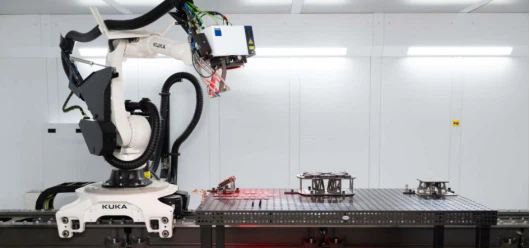
Thanks to the integrated high-precision PFO 3D galvanometer, the laser achieves high-speed, flexible operation in three-dimensional space.
Efficiency, Quality, and Team Confidence Soar
The laboratory's launch delivered immediate efficiency gains for NITIU. "Concept validation that once took weeks is now routinely completed from morning experiments to next-day implementation," Hainsworth noted with satisfaction. "Quality has improved, processes are more stable, and the team continues to learn and advance." TRUMPF precisely tailored the system to NITIU's workflow, providing a comprehensive turnkey solution. Hainsworth emphasized: "We could have chosen multiple suppliers, but TRUMPF's integrated solution was pivotal. It allows us to focus entirely on our core technology without distractions from coordinating different vendors."
Moving Forward: Lightweight, Robust, Laser-Engineered Precision
With its new laser center, NITIU has taken a crucial step toward developing efficient, lightweight, and safe hydrogen storage tanks. What was once a vision is now materializing into tangible, lightweight, robust components forged through laser precision engineering. "Sometimes it still feels unbelievable," Hainsworth remarks with a smile, "but this is truly the coolest thing we've ever done." This technological breakthrough not only grants NITIU a competitive edge but also injects powerful momentum into the decarbonization of transportation, accelerating the hydrogen economy onto the fast track.


