


Recently, a joint research team of Associate Researcher Meizhi Sun at the Joint Laboratory of High Power Laser Physics, Shanghai Institute of Optical Precision and Mechanical Research, Chinese Academy of Sciences (SIPMR) and Associate Researcher Xiaoniu Tu at the Shanghai Institute of Silicate Technology, Chinese Academy of Sciences (SISTR), has proposed a new configuration for XOPA (Cross-Farper Intra-cavity Optical Parametric Amplification), which has been demonstrated by an experimental demonstration based on the front-end of the SG-II 5PW laser device. The results were published in Laser Photonics Reviews under the title of "Optical Parametric Amplification in Crossed Fabry-Perot Cavities".
Optical Parametric Amplification (OPA) and Chirped Pulse Optical Parametric Amplification (OPCPA) are the most important technology routes for high power laser systems, and the mainstream technology routes for tens to hundreds of megawatts laser systems in the future. The development of this field puts comprehensive requirements on laser amplification technology in terms of efficiency, energy, bandwidth, gain, beam quality, signal-to-noise ratio and shaping capability.
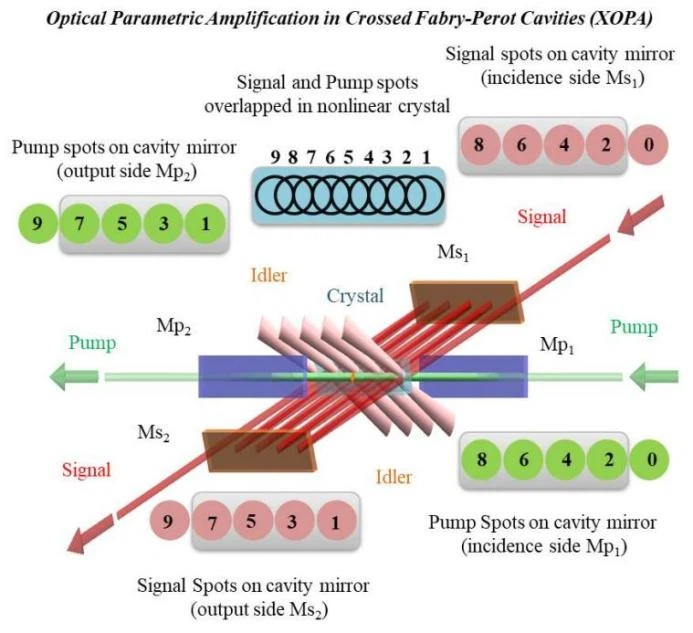
Fig. 1 Schematic diagram of XOPA configuration
The research team puts the nonlinear crystal inside the cross-farper cavity, constrains the signal light and pump light to realize multi-pass transmission and energy conversion, eliminates the idle light in stages, and suppresses the mixing three-wave energy reflux, so as to realize the monotonic extraction of the energy of the signal light to the pump light. Experimentally using the YCOB crystal provided by Shanghai Institute of Silicate Research, the 800nm band signal light to pump light conversion efficiency of 56.28%, spectral width of 120nm output capacity; in addition, the researchers designed unequal cavity length of the double Fapper cavity, to achieve the chirped pulsed signal light of high-contrast amplification and shaping. This study shows that the XOPA configuration has the ability to shape in time, space and frequency domains under the premise of high conversion efficiency, and is universally applicable to all bands and all nonlinear crystals for noncollinear optical parametric amplification, which is of great significance for improving the comprehensive performance of high-power laser systems.
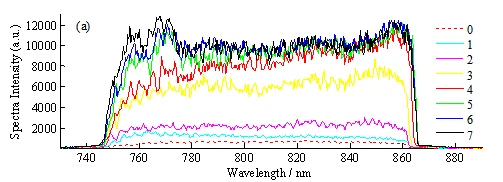
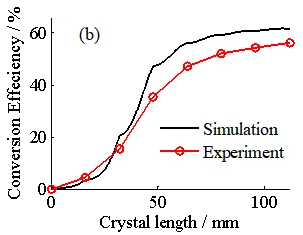
Fig. 2 Theoretical simulation and experimental results of (a) spectral evolution and (b) conversion efficiency of the 7-pass amplification process of XOP


