


The transmission of electromagnetic waves (e.g., lasers) in plasma is a fundamental problem in plasma physics. Generally, electromagnetic waves cannot be transmitted in overdense plasmas, but their transmission and energy transfer play a key role in applications such as fast-ignition laser fusion, laser particle acceleration, and ultrashort and ultrabright radiation sources. 1996, Prof. S.E. Harris of Stanford University was inspired by the concept of electromagnetically induced transparency (EIT) in atomic physics. Electromagnetically Induced Transparency (EIT) in atomic physics, Prof. S.E. Harris proposed the mechanism of Electromagnetically Induced Transparency (EIT) in plasma, i.e., with the help of a beam of high-frequency laser light, low-frequency laser light, which is originally unable to be transmitted, can be transmitted in a high-density plasma. However, subsequent studies have shown that EIT cannot occur in real plasmas with boundaries, but these studies are limited to the weak relativistic laser intensity range.
Recently, a research team of Researcher Yutong Li at the Institute of Physics, Chinese Academy of Sciences/National Research Center for Condensed Matter Physics, Beijing, and Professor Weimin Wang at the Department of Physics, Renmin University of China, using the self-developed KLAPS particle simulation program, found that after a low-frequency laser is incident into a plasma at the same time as a relativistically-intensified high-frequency laser, the low-frequency laser can penetrate into this plasma; however, when the polarization of the two lasers is perpendicular, this anomalous However, when the polarizations of the two laser beams are perpendicular, this anomalous transmission phenomenon disappears, thus ruling out the common relativistic transparency effect. The team developed a three-wave coupling model at relativistic light intensities, which gives the frequency passband in which EIT occurs. Under relativistic light intensity, the width of this passband is sufficient to ensure stable transmission of low-frequency lasers; however, under weak relativistic light intensity, the passband narrows to an isolated point, which is difficult to sustain, and this explains why the EIT effect could not occur under weak relativistic conditions in previous studies. This work shows that the electromagnetically induced transparency effect that occurs in atomic physics can also occur in plasma physics. This phenomenon can be directly applied to double-cone collision ignition (DCI) and fast-ignition laser fusion to improve laser coupling efficiency and fast electron yield.
The research results were published on February 7, 2024 in Physical Review Letters under the title "Electromagnetically Induced Transparency in the Strongly Relativistic Regime". Physical Review Letters). Tiehuai Zhang, a PhD student at the Institute of Physics, Chinese Academy of Sciences (IPS), is the first author of the paper, while Prof. Weimin Wang of Renmin University of China, Yutong Li of IPS are the corresponding authors, and Academician Jie Zhang is the co-author. The topic of this research comes from the "Novel Laser Fusion Program" of the Strategic Pilot Project (Class A) of the Chinese Academy of Sciences, led by Academician Jie Zhang, and supported by the National Natural Science Foundation of China and other organizations.

Figure 1: [(a), (b)] Frequency spectra of the collected laser field behind the bounded plasma region and [(c), (d)] Evolution of the filtered laser field waveforms with time, where the different curves correspond to the incidence of the two-color field mixing, purely pumped wave, and purely low-frequency wave. (e), (f)] Evolution of the filtered laser field waveforms with time for the incident two-color field mixing, where the blue and red lines correspond to the polarization parallelism and perpendicularity, respectively. The upper and lower lines correspond to the two initial settings of high and low density, respectively.
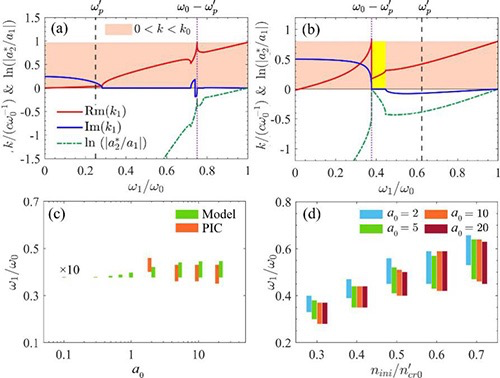
Figure 2: Dispersion relations of the dominant branch of the Stokes wave given by the analytical model for (a) the high-density setup versus (b) the low-density setup, where a wider passband (highlighted in bright yellow) appears. (c) One-dimensional PIC simulation results for different light intensities after fixing the ratio of the initial plasma density to the effective critical density with the EIT passband positions given by the model. (d) PIC simulation results with passband positions given by the model for different light intensities and different density settings.

Figure 3: Evolution of the signal intensity of Stokes wave (blue line, left axis), inverse Stokes wave (black line, left axis) and pump wave (red line, right axis) with respect to the spatial position, with the plasma uniformly distributed in the interval of 10λ0 < x < 30λ0 for initial conditions. (The (a)-(c) plots have the same light intensity and different initial densities. (The (d) plot gives the simulation results for the weakly relativistic case, which are consistent with the conclusions of previous studies.


