

Nonlinear effect suppression and mode control are the current technical challenges for power enhancement of high-power ytterbium-doped fiber laser (YDFL). Increasing the YDF core diameter is beneficial to improve the SRS threshold, but leads to more difficult higher-order mode control and difficulty in achieving high beam quality. Compared with uniform double-cladding fibers, tapered fibers have certain advantages in balancing SRS suppression and mode control. The small core diameter part of the tapered fiber can reduce the number of core guiding modes to achieve effective mode control, while the large core diameter part is conducive to reducing the core power density to improve the SRS threshold.2022, the National University of Defense Technology (NUDT) based on the uniform double-clad ytterbium-doped fiber has achieved a laser output of 20 kW, with a beam quality M2 factor of 3.3.2023, and in order to further improve beam quality, the team carried out theoretical and practical studies of the TYDF laser, the TAPered Ytterbium-doped Fiber ( TYDF) laser theoretical and experimental research.
Research Progress
To improve the SRS threshold, the laser adopts a backward-pumped master oscillator power amplification (MOPA) structure, as shown in Fig. 1. 1080 nm seed light is injected from the small end of the TYDF sequentially through the mode field adapter (MFA), tilted grating (CTFBG), and cladding optical filter (CPS 1). 1018 nm pump light is injected into the large end of the TYDF through the backward (6 + 1) × 1 combiner beam (PSC) pumping arm. injected into the large end of the TYDF. The amplified signal light is output through the cladding optical filter (CPS 2) and the fiber end cap (QBH).The pigtail of CPS 1 is a 30/250 μm double-clad energy transfer fiber.The pigtails of PSC, CPS 2 and QBH are all 48/400 μm double-clad energy transfer fibers.The TYDF is designed and developed independently by National University of Defense Technology (NUDT). National University of Defense Technology independent design and development of the TYDF its small core diameter region of the core / inner cladding diameter of 30/250 μm, large core diameter region of the core / inner cladding diameter of 48/400 μm, core numerical aperture of 0.066, cladding absorption coefficient of about 0.36 dB / m @ 1018 nm, TYDF optical fiber in the small core diameter region, tapered area, the length of the core diameter region of the large core diameter of 15 m, 30 m, 15 m. TYDF fiber length of the small core diameter region, tapered area, the large core diameter region, respectively, TYDF is fixed on the fiber water-cooled plate by spiral coiling, and the minimum coiling diameter is more than 25 cm.

Figure 1 20 kW fiber laser structure schematic diagram
The laser output power variation is shown in Fig. 2(a). 200 W of 1080 nm seed laser output power after amplifier is 160 W. When the highest pump power injected into the TYDF is 24.8 kW, the output laser power is 20.2 kW, which corresponds to the overall slope efficiency of 80.8 %. The spectrum at the highest output power is shown in Fig. 2(b), where the SRS suppression ratio is 33 dB and there is no obvious Raman light component. The M2 factor of the beam quality at different powers (measured with a Primes LQM 200 with a collimator focal length of 120 mm) is shown in Fig. 2(c). The M2 factor of 2.18 at 13.5 kW is a significant improvement compared to the results of the Team 2022 measurements based on a 48/400 μm homogeneous fiber at the same power (M2 = 2.8).
Due to the small laser spot (LQM 200 incident spot diameter needs to be less than 15 mm), with the increase of output power, the thermal effect of the collimator lens intensifies, resulting in obvious out-of-focus phase aberration and spot aberration, so the accurate measurement of M2 at 20 kW output power is not possible for the time being. The beam quality β factor was also tested in the experiment using a beam quality measuring instrument (GYM-100) developed by the Hefei Institute of Physical Sciences, Chinese Academy of Sciences, in accordance with the "GJB 7367-2011 Method for Measurement of β Quality Factor of High-Energy Laser Beams". Due to the use of a large spot collimator with a long focal length (190 mm), the influence of the thermal effect of the collimator on the measurement results was alleviated to a certain extent. the β factor at 13.5 kW was 1.92, and the β test results at 20 kW are shown in Fig. 2(d). the minimum value of β factor was 1.93, the maximum value was 2.05, and the average value was 1.99 at 150 s. The β factor was 1.99 at 13.5 kW, and the average value was 1.99 at 20 kW.
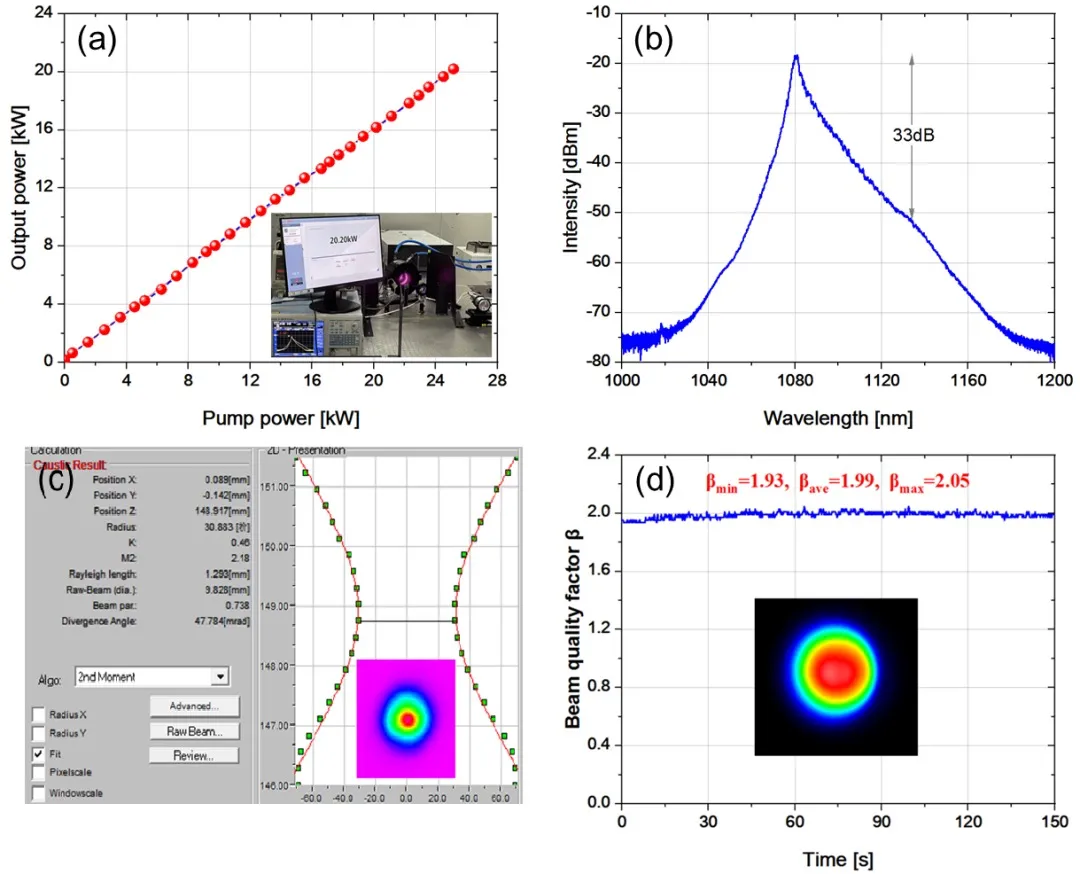
Figure 2 Laser output power and test results
Future Prospects
Because there is no precise conversion method between β-factor and M2-factor, the real value of M2-factor at 20 kW cannot be derived from the β-factor test results for the time being. However, comparing the 20 kW laser realized by the team in 2022 based on 48/400 μm uniform YDF (the average value of β-factor is 2.94 based on the same test system), the beam quality has been significantly improved. The experimental results validate the feasibility of tapered fiber to improve beam quality. In the follow-up work, the team will continue to optimize the structural parameters of the TYDF and fiber device to achieve further improvement in power and beam quality.

Jan 15, 2024
Leave a message
NUDT Achieves 20kW High Beam Quality Laser Output Based On Tapered Ytterbium-doped Fiber
Send Inquiry


