


Narrow-linewidth lasers are crucial in a wide range of applications, including precision sensing, spectroscopy, and quantum science. In addition to spectral width, spectral shape is also an important factor, depending on the specific application. For example, power on either side of the laser line may introduce errors in the optical manipulation of quantum bits and affect the accuracy of atomic clocks. Regarding laser frequency noise, the Fourier components generated by spontaneous emission into the laser mode typically exceed 105 Hz, and these components determine the amplitude on either side of the linewidth. Combined with the Henry enhancement factor, these factors collectively define the quantum limit, known as the Schawlow-Townes (ST) limit, which establishes the achievable lower limit of the effective linewidth after eliminating technical noise such as cavity vibrations and length drift.
Therefore, minimizing quantum noise is a critical aspect of narrow-linewidth laser design. In practice, the desired linewidth is achieved by adjusting the key factors of the ST limit: laser power, using high-Q-factor cavities, and selecting gain media with low field amplitude-refractive index coupling (low Henry factor). Lasers such as titanium sapphire lasers, fiber lasers, and external cavity semiconductor lasers are typical examples of lasers capable of achieving the hertz-level linewidth required for many of the most demanding coherent laser applications. However, designing lasers that simultaneously meet the linewidth, power, and wavelength requirements of a given application remains challenging.
Researchers at Macquarie University tested this technology using diamond crystals, which offer excellent thermal performance and provide a stable testing environment. They tested an intentionally created "noise" input beam with a linewidth exceeding 10 MHz using a diamond crystal with a diameter of just a few millimeters within a cavity. Their Raman scattering technique compressed the output laser beam's linewidth to 1 kHz, the limit of their detection system, achieving a compression factor exceeding 10,000 times.

Figure 1. Single-sided PSD measurement results show significant noise narrowing of the pump seed and Stokes components at high frequencies.
The research team utilized the principle of stimulated Raman scattering to excite higher-frequency vibrations within the material, achieving a linewidth narrowing effect thousands of times more effective than traditional methods. Essentially, this represents a new laser spectral purification technology applicable to various types of input lasers, marking a fundamental breakthrough in laser technology.
This new technology addresses the issue of minor random temporal variations in light waves that cause a decline in laser beam purity and reduced precision. In an ideal laser, all light waves should be perfectly synchronized-but in reality, some light waves may slightly lead or lag behind others, causing fluctuations in the phase of light. These phase fluctuations generate "noise" in the laser spectrum-blurring the laser's frequency and reducing its color purity.
The principle of Raman technology is to convert these temporal irregularities into vibrations within a diamond crystal, which are rapidly absorbed and dissipated (within a few trillionths of a second). This leaves the remaining light waves with smoother oscillations, resulting in higher spectral purity and a significant narrowing effect on the laser spectrum.
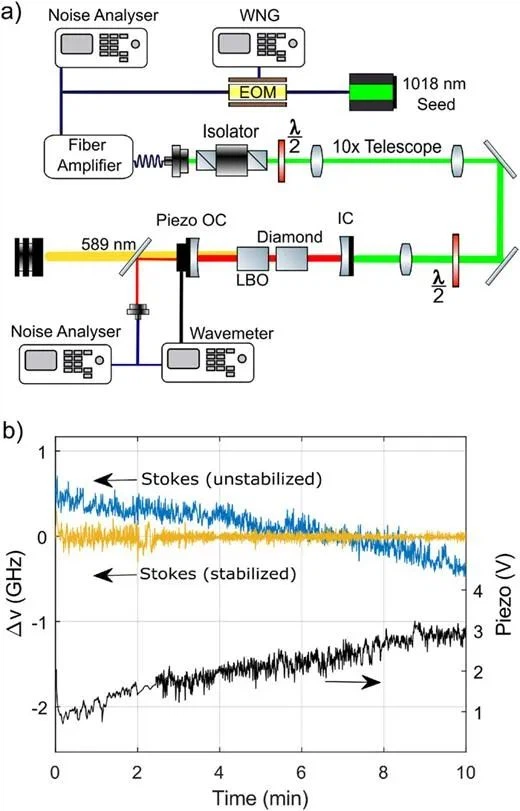
Figure 2. (a) Schematic diagram of the laser system, showing key components. WNG: white noise generator, OC: output coupler, IC: input coupler, EOM: electro-optic modulator, LBO: lithium borate, λ/2: half-wave plate. (b) Stokes frequency drift with feedback (orange) and without feedback (blue). For the feedback case, piezoelectric voltage is included to indicate drift compensation.
In addition to its exceptional linewidth narrowing effect, researchers found that its Raman technique offers multiple advantages over traditional Brillouin methods, including achieving smaller minimum linewidths. These ultra-narrow linewidth lasers have several cutting-edge application areas:
Quantum computers: Manipulating quantum bits (qubits), the fundamental units of quantum information, requires extremely precise laser control. Current lasers introduce phase noise, leading to errors in quantum computing. Improved spectral purity will enhance the reliability of quantum computers.
Atomic clocks: Atomic clocks form the foundation of GPS navigation. Higher spectral purity will enhance their performance and may drive new discoveries in fundamental physics in the future.
Gravitational wave detection: Gravitational wave detectors, which measure extremely small distortions in spacetime, can become more sensitive by using laser beams with narrower linewidths, potentially enabling the detection of weaker signals from distant cosmic events.


