


The performance of fuel injection systems has become a core area of competition in the automotive industry, driven by both the tightening of global environmental regulations and the improvement of internal combustion engine efficiency. As the core component of the engine fuel injection system, the processing accuracy of the injector nozzle directly determines the fuel atomization effect, combustion efficiency and pollutant emission level. Traditional processing technology cannot achieve the required level of precision. Femtosecond laser processing can realize precise control of the injector nozzle aperture, which has a great impact on engine efficiency.

Fuel Injector Microporous Machining Pain Points?
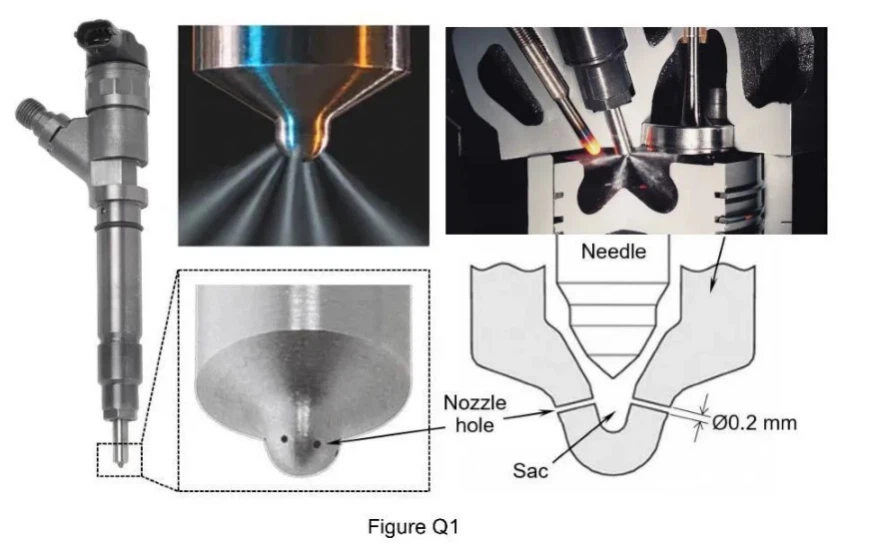
When gasoline is ejected at high speed from the orifice of the direct injector (GDI) nozzle, it undergoes a three-phase transformation process of "liquid injection → droplet fragmentation → atomization and evaporation", and eventually mixes with the air in the cylinder to form a combustible mixture. In this process, the three-dimensional geometric accuracy of the nozzle hole and the smoothness of the inner wall directly determines the atomization quality and distribution uniformity of fuel injection:
If the injector nozzle hole processing is not fine, such as the edge of the burr, hole wall with residual impurities, high-speed injection of fuel will be due to uneven force, the formation of droplets of varying sizes. These not fully atomized "oil beads" will be attached to the engine cylinder wall, did not participate in the combustion of the part will become pollutants discharged, resulting in exhaust gas testing of hydrocarbon indicators exceeded, but also make the engine more prone to carbon deposits, affecting the life and performance.
Limitations of Traditional Processes
- Electrical Discharge Machining (EDM)
Hole size limitation: It is difficult to process micro-holes <145μm stably, which cannot meet the demand of new generation fuel injection system.
Inefficiency: long machining time for single holes and electrode losses significantly push up tooling costs.
- Conventional Laser Processing
Thermal damage issues: nanosecond/microsecond laser light causes material to melt and recondense, forming burrs and recast layers and affecting atomization uniformity.
Post-processing dependency: additional grinding processes are required to repair the quality of the hole wall, increasing the complexity of the process.
- Hybrid process
The hybrid process of "laser pre-drilling + EDM finishing" can reduce processing time by 70% and improve the heat-affected zone, but it still requires multi-process coordination and faces challenges such as hole alignment accuracy and equipment compatibility.
Core Advantages of Femtosecond Laser Processing
What is a femtosecond laser? Compared with general lasers, femtosecond lasers utilize ultra-short pulses (pulse width <100 fs) with ultra-high peak power to induce multi-photon absorption, avalanche ionization, and other non-linear effects on the surface or inside the material to achieve "cold machining" - with a very small heat-affected zone (<1μm), avoiding cracks, re-cracking, and the need to remove the heat-affected zone from the material. m), avoiding cracks, recast layers and other defects.
Customized Hole Shapes: Positive Taper, No Taper, Inverted Taper
As a precision-engineered fluid transfer device, hole taper plays a crucial role in flow characteristics, including velocity and reaction efficiency. Traditional technologies are limited by processing principles that make it difficult to realize inverted taper orifices, resulting in deviations between actual jet performance and design parameters.
Monochrome Technology's femtosecond laser is equipped with taper-controllable technology, which realizes a customized aperture taper angle of 0~1.15° through the adjustment of beam incidence angle and spatial shaping, and is capable of realizing the precision hole-making of complex structures such as three-dimensional curved surface distributions, with an accuracy of ±1 μm, including the roundness, taper, depth, and consistency between the holes, which helps to improve the atomization effect.
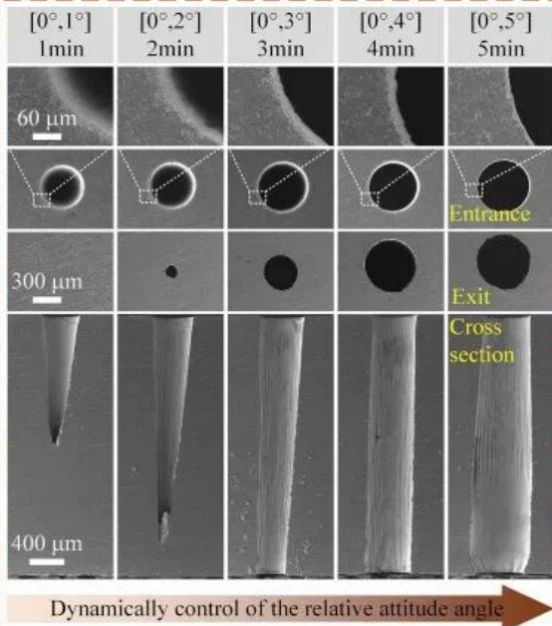
Femtosecond laser processing of controlled tapered micro-holes based on dynamic control of relative attitude" Xiaomao Sun et al., Optics & Laser Technology Volume 170 (2024.3)
Process Simplification: From Multi-Step to One-Step Molding
Monochrome Technology matches the parameters of femtosecond laser energy and pulse frequency based on material properties, and combines them with a vision positioning system to achieve sub-micron alignment accuracy. Through the 5-axis platform to realize multi-angle focusing of the laser beam, complex micro-hole structures (tapered holes, 3D tilted holes) are processed in one step, with smooth edges of micro-holes (surface roughness Ra ≤ 1 μm) without the need for secondary trimming. The hole diameter is usually 100 microns to several hundred microns, the thickness can be up to 2 millimeters, and the hole diameter to depth ratio is less than 10:1.
According to Research and Markets, the global injector nozzle market was valued at $7.3 billion in 2024 and is expected to reach $9.8 billion by 2030, growing at a CAGR of 5% from 2024 to 2030. As the world's largest automobile manufacturing country, the demand for related parts is expected to grow at a high rate. With its self-developed femtosecond laser micro-nano machining solutions, Monochrome Technology can efficiently and precisely make holes in liquid atomization and spraying systems, and is committed to providing China's advanced manufacturing solutions for the upgrade of the global manufacturing industry.


