


Before L4 autonomous driving and embodied intelligence businesses become profitable, leading lidar companies are gradually crossing their respective break-even points.
Among the three lidar companies on the Hong Kong Stock Exchange, Hesai Technology has achieved full-year profits, Sagitar Juchuang has achieved single-quarter profits, and Tudatong has achieved positive gross profit.
According to previously disclosed financial reports, Hesai Technology achieved a full-year net profit of 436 million yuan in 2025, becoming the world's first GAAP profitable lidar company; Sagitar Juchuang achieved a single-quarter profit for the first time in the fourth quarter of 2025, with a net profit of 104 million yuan.
Lidar is a key upstream component for autonomous driving and robots. Lidar mainly solves the three core needs of positioning, navigation and obstacle avoidance in the field of robotics, and has been widely used in lawn mowing robots, humanoid robots, unmanned delivery vehicles and other scenarios.
Although the revenue share of the robot business is not high, using the scale of vehicle-mounted lidar in exchange for revenue cash flow, the high gross profit of robot lidar provides room for imagination for profit growth:
Hesai will ship 1.38 million ADAS units and 239,300 robot units in 2025, a year-on-year increase of 425.8%. The robot business with a gross profit margin of over 37% has increased the overall gross profit margin to 41.8%.
Sagitar's path is similar, with annual ADAS sales of 609,000 units, a year-on-year increase of only 17.2%, and robot and other product sales of 303,000 units, a year-on-year increase of 1,141.8%. Robot sales in the fourth quarter were 221,200 units, a year-on-year surge of 2565.1%. Robot revenue in the fourth quarter was 347 million yuan, which was almost the same as ADAS revenue.
Tudatong is still losing money but has taken the first step. Its pan-robotics business revenue was 135 million yuan, a year-on-year increase of 130%, driving the gross profit margin to turn positive from -8.7% to 7.9%.
The cost difference is more intuitive. Hesai's JT series for lawn mowing robots is priced as low as a thousand yuan, which is about twice the price of automotive lidar, but the absolute value is still far lower than the tens of thousands of dollars a few years ago.
But the problem is that the scale of robots is far less than that of cars. The unit price of a lawn mower lidar may be twice as expensive as that of a car, but the annual shipment level of lawn mowers is completely incomparable with the tens of millions of passenger car markets.
However, Qiu Chunchao, CEO of Sagitar Juchuang, said at the performance meeting that the sales volume of lidar in the field of robotics is expected to triple from last year in 2026, reaching expectations of 800,000 to 1 million units.
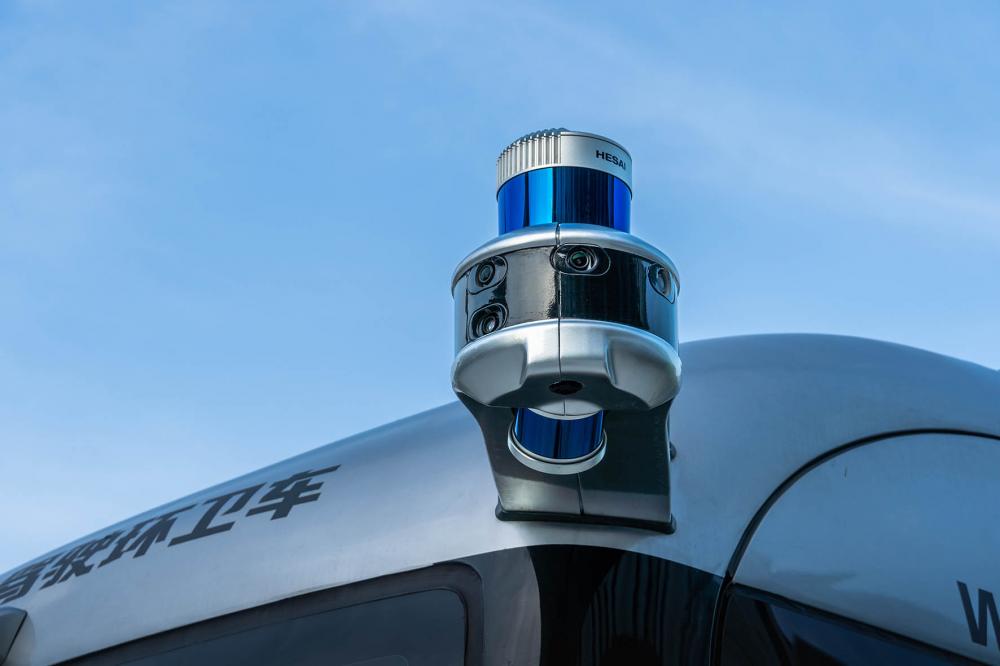
ADAS business has small profits but quick turnover, and self-developed chips have become the key to cost reduction
The price of automotive lidar dropped from US$80,000 to US$200 in less than ten years.
In 2016, Velodyne's 64-line mechanicalsold for US$80,000. By 2022, models equipped with lidar will mainly be in the price range of more than 450,000 yuan, and models such as NIO ET7 and Ideal L9 will begin to be equipped with lidar as standard.
In April 2024, Sagitar Juchuang released the MX, priced at less than US$200 (approximately RMB 1,450). The first designated project will be mass-produced in the first half of 2025. In 2025, the Hesai ATX is also available for less than $200, which is about half the price of the AT128 model.
In the logic of manufacturing, falling prices should force cost control. But in the field of automotive lidar, price reduction comes before cost reduction, and OEMs have sufficient bargaining and cost control capabilities.
Lidar has changed from a high-end option to a safety standard and is the ticket to enter the mainstream market. In the new energy vehicle market, the threshold for adoption has been lowered simultaneously, and 100,000-yuan models such as the Leap A10 and Changan Qiyuan Q05 have begun to be equipped with lidar as standard.
The expansion of the new energy vehicle market has brought a quantum leap to lidar companies. For the whole year of 2025, Hesai's ADAS lidar shipments reached 1.3811 million units, a year-on-year increase of 202.6%; Sagitar ADAS products' annual sales reached 609,000 units, a year-on-year increase of 17.2%; Tudatong's ADAS products increased by 32.4% year-on-year to 300,000 units.
However, gross profit margin is still climbing at a low level. The gross profit margin of Sagitar's ADAS products increased from 13.4% to 19.1%, and the comprehensive gross profit margin for the year reached 26.5%; the gross profit margin of Tudatong's ADAS business fell to 6%; although Hesai's ADAS business was not separately disclosed, its overall gross profit margin reached 41.8%, mainly due to the high gross profit of the robot business.
In the context of small profits but quick turnover, cost reduction has become the only way out. "The current cost of lidar is mostly in the SPAD chip, and almost every company is promoting self-development." said a lidar engineer.
Hesai's fourth-generationarchitecture platform will be fully mass-produced in 2025, with the same goal of "high quality, high performance, and low cost." Li Yifan, the founder and CEO of Hesai Technology, mentioned in the press conference that Hesai has reduced the cost of lidar by 99.5% through technology iteration, from the initial US$200,000 to US$200.
In 2025, the gross profit margin of Sagitar ADAS products will increase from 13.4% to 19.1%. The core reason is to use the self-developed SPAD-SoC receiving and processingto replace the FPGApurchased from a third party. It integrates the signal processing, point cloud generation and other tasks originally completed by the FPGA into a car-grade chip. After replacing the FPGA solution, the circuit board area is reduced by 50%, power consumption is reduced by 40%, and the cost is also reduced.
The financial report shows that the average price of Tudatong ADAS products will drop from US$662 in 2024 to US$443 in 2025, a decrease of 33.1%. According to calculations based on financial report data, the unit price of Hesai's ADAS products will drop from approximately 3,900 yuan in 2024 to approximately 1,800 yuan in 2025, a drop of more than half.
Pan-robotics business expands growth boundaries
Robots are becoming the second growth curve for lidar companies.
A lidar engineer explained to reporters that the cost of customized development of robots is high and it is difficult to dilute R&D expenses. The scale of mass production has not yet been established, and the bargaining space in the supply chain is limited. This is also the reason why the unit price of robot lidar is much higher than that of ADAS products.
The gross profit margin of the robot business is stable at more than 37%, and the gap between the gross profit margin and the automotive lidar is more than 20 percentage points. Hesai's management admitted in the financial report that the gross profit margin of ADAS products is usually lower than that of robotic lidar.
At present, in the field of pan-robotics, the main applications of lidar are concentrated in lawn mowing robots, humanoid robots, unmanned distribution and industrial logistics.
Lidar mainly solves three core problems in the field of pan-robotics, namely precise positioning, environment perception and obstacle avoidance, and path planning and navigation. Compared with 2D lidar, which can only scan flat surfaces and cannot identify depressions on the ground. Compared with the GPS + camera solution, which is affected by indoor signals and lighting, 3D lidar makes up for these shortcomings. In practical applications, it is usually integrated with AI vision algorithms and SLAM technology to form a multi-modal perception solution.
A lawnmower supports the most realistic commercialization path of lidar. For example, Sagitar stated in its financial report that it had obtained an exclusive order from Weilan Continent, a subsidiary of Nine Company, and recently won an exclusive order from a head cleaning robot brand; Hesai said it had signed a global exclusive supply agreement with Zhuimi for 10 million JT series lidars, setting a record for a single order in the field of consumer robots.
The perception scheme of humanoid robots is more complicated. 3D structured light, iToF, binocular stereo vision and lidar coexist. However, the 360° zero blind zone three-dimensional perception provided by lidar is still irreplaceable in highly dynamic scenes. Both of Yushu Technology's humanoid robots are equipped with Hesai JT128. Honor's first humanoid robot also uses the JT series, completing actions such as congratulations, handshakes, and backflips.
Lidar is also indispensable in logistics and industrial scenarios. Tudatong's Lingque W wide-angle lidar is used for indoor forward-moving robots and intelligent handling robots. It has a field of view of 120°×70° and a frequency output of 1.28 million points per second. It covers the blind spots of forklifts and achieves precise obstacle avoidance and cargo grabbing. Public information shows that Tudatong has won orders from leading companies such as Jiushi Intelligence, Uisee Technology, Kusa Technology, and Zhongli Digital Intelligence, covering scenarios such as urban distribution, airport connections, sanitation operations, and industrial handling.
Sagitar is also investing in the field of L4 unmanned delivery. In March 2026, Sagitar and Neolix reached a strategic cooperation to equip all new-generation RoboVan series with digital main lidar and all-solid-state blinding lidar as standard, with orders exceeding 300,000 units. This is one of the largest lidar orders disclosed in the field of unmanned delivery.
In March 2026, Hesai announced that it would become Neolithic's largest lidar supplier, supplying ATX and FTX series products for the new generation of L4-level unmanned city vehicles, covering all Neolithic's large-scale mass-produced vehicles.
In 2025, Hesai Robot LiDAR will ship 239,300 units, a year-on-year increase of 425.8%; Sagitar robots and other products will sell 303,000 units, a year-on-year increase of 1141.8%; Tudatong Robot LiDAR will ship approximately 32,000 units, a year-on-year increase of nearly 10 times. The growth rates of the three robot businesses are significantly ahead of their respective vehicle-mounted businesses.
However, downward price pressure is also transmitted to the robotics field. The unit price of Tudatong robot lidar will drop from US$2,714 in 2024 to US$594 in 2025, a decrease of 78.1%. Even so, it is still about 34% higher than its ADAS products. The average unit price of Sagitar robot business dropped from about 8,100 yuan to about 2,300 yuan, and dropped to 1,600 yuan at the peak of shipments in the fourth quarter.
Sinolink Securities defines lidar as "a next-generation universal sensor that is expected to cover all generalized robot scenarios in the future." West China Securities believes that "it is expected to recreate N passenger car markets in the future." Lawn-cutting robots, humanoid robots, unmanned delivery vehicles, unmanned forklifts, AGVs, Robotaxi, surveying and mapping, drones, etc., the list of application scenarios continues to grow.
This time, lidar stands on the same commercial track as consumer-grade and commercial-grade robots.


