


Recently, a research team from the Joint Laboratory of High Power Laser Physics, Shanghai Institute of Optics and Precision Machinery, Chinese Academy of Sciences (SIPM, CAS), has identified and analyzed the anomalous near-field outputs of the SG-II upgraded device by using the airspace computational method and the deep learning model with the attention mechanism to meet the real-time and validity requirements for the analysis of the multiple near-field outputs of the high-power laser device. The related results are summarized as "Near-field analysis of the high-power laser facility using calculated methods and a residual convolutional neural network with attention mechanism" in Optics and Lasers in Engineering.
Inertial confinement fusion (ICF) physics research places very stringent requirements on the output performance and reliability of high-power laser drivers, in which a uniform distribution of the near-field is conducive to enhancing the system operating flux, protecting the subsequent optics, and meeting the requirements for long-term high-intensity and reliable operation of the system. High-power laser devices contain multiple laser beams, and manual identification methods are not timely and effective enough; therefore, effective methods are needed to analyze the near-field state at different moments and provide timely warnings. Convolutional neural networks (CNNs) have powerful feature extraction capabilities and can be trained on historical data to meet the needs of complex and diverse tasks.
The researchers propose to utilize an airspace computation method and a residual convolutional neural network model with an additional attention mechanism to initially assess the operational status of the SG-II upgraded unit based on a large number of near-field images at different times. The airspace computation method is used to batch process CCD-detected near-field images, and changes in the uniformity of the near-field distribution over the device's continuous operation time can be analyzed by the modulation regime and contrast. The algorithm automatically extracts valid near-field spot regions, which also provides a preprocessing step for the images used to train the convolutional neural network model. The convolutional neural network model is used to automatically identify and classify near-field image features with multiple labels to enable the detection of fundamental frequency (1ω) near-field state anomalies. In this work, the researchers selected six features including near-field distribution uniformity, anomalous output signals, and strong diffraction loops to be analyzed, and the classification accuracy of the model reached 93%, and the model was able to make real-time judgments on any number of near-field images with respect to the above six features.
In subsequent studies, as the amount of experimental data increases, the researchers will refine the classification labels of the anomalous features, especially the similar features, in order to build a more robust model. This work explores the effective application of deep learning models in ICF high-power laser devices, and is expected to continue to expand the application of deep learning models in the future to provide intelligent analysis means for large laser devices.

Fig. 1 Results of the airspace calculation method (a) CCD acquired image (b) Histogram of near-field gray level distribution (c) Histogram of near-field gray level distribution after removing the background (d) Binary image after removing the background (e) Rotated near-field image after the Hough transform (f) Rotated binary image (g) Cropped near-field image (h) 85% region of near-field image
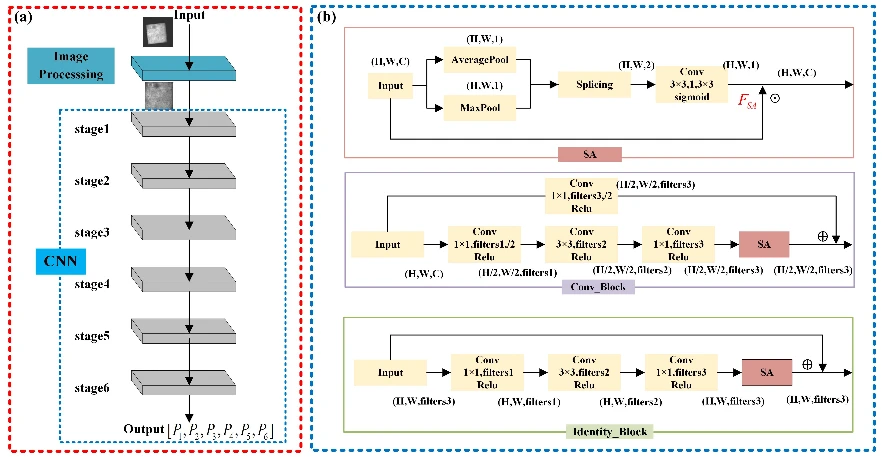
Fig. 2 Structure of the spatial attention residual convolutional neural network model


