

Recently, the Sino-Russian Joint Research Center for Atmospheric Optics (JRCAO) has made new progress in collaborative research on experimental and theoretical studies of cirrus lidar detection. The results were published in Optics Express of the Optical Society of America (OSA) by the team of researcher Zhuzhu Wang from the An Optical Institute of the Hefei Institute of Physics, Chinese Academy of Sciences, and the team of Prof. Alexander Konoshonkin from the Institute of Atmospheric Optics of the Russian Academy of Sciences in Zuyev, Russia.
Cirrus clouds cover more than 30% of the global airspace and are one of the key factors influencing the radiative balance of the earth-air system. In order to meet the needs of the Earth-Air System Model, in-depth studies of cirrus microphysics are required. Previous lidar detection experiments have often ignored the hollow ice crystal particles in cirrus clouds, yet more than 50% of the hollow columnar ice crystals in the real atmosphere have been captured by the Cloud Particle Imager (CPI). In order to elucidate this issue, the project team established the first Modal Hollow Ice Crystal (MHC) model for mid-latitudes to fit the description of hollow ice crystals in nature, and found that when the mixing ratio of solid particles to hollow particles reaches 50% and above, it is possible to differentiate between solid particles and hollow particles based on the Lidar ratio of the wavelength of 1064 nm, the color ratio of 1064/532 nm, and the de-polarized ratio of 532 nm, further obtaining accurate microparticles. mixing ratios to further obtain accurate microphysical parameters.
This study was supported by the National Natural Science Foundation of China, the Natural Science Foundation of Anhui Province, and the program of the Chinese Academy of Sciences.

Variation of backscattering properties of randomly oriented columnar ice crystal particles with size
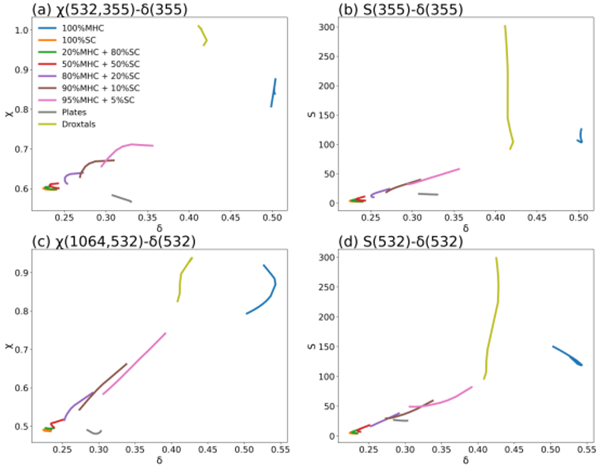
Relationship between LIDAR characteristic parameters for different combinations of ice-crystal particles

Nov 16, 2023
Leave a message
Russian-Chinese Joint Research Center For Atmospheric Optics Makes New Progress in Characterization Of Hollow Cirrus Particles
Send Inquiry


