


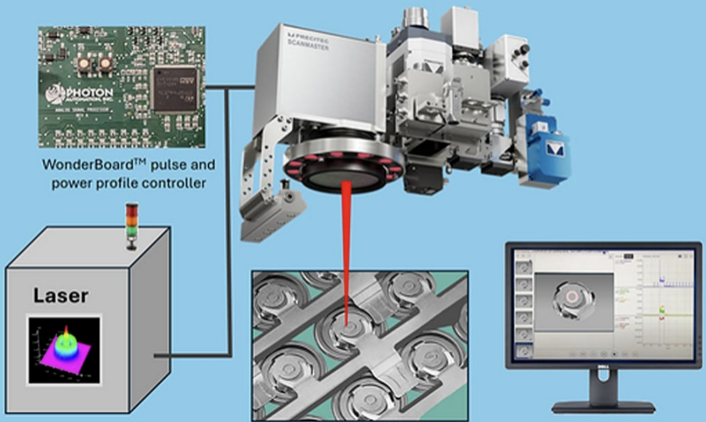
Figure 1: Laser welding setup for cylindrical lithium-ion battery modules. (Image source: Photon Automation)
Cylindrical lithium-ion batteries (such as 18650, 21700, and larger 4680 models) are widely used in portable electronics, power tools, energy storage systems, and especially electric vehicles due to their high energy density, standardized design, and proven reliability. These batteries typically employ nickel-plated steel (Hilumin) as the casing material, as the nickel coating provides corrosion resistance while the steel substrate ensures structural strength to withstand internal pressure and mechanical stress.
To meet specific design and performance requirements, some 46 mm diameter cylindrical cells employ different casing materials like aluminum and nickel-plated steel. A critical challenge during module or battery pack manufacturing is welding aluminum and steel together, due to significant differences in their thermal properties and welding behavior.
Constructing cylindrical battery modules or packs involves arranging cells (individual battery units) in a specific pattern and connecting them in series or parallel according to the application's voltage and current requirements. This configuration allows manufacturers to customize the overall energy capacity and power output of the battery pack to meet the demands of specific applications, such as electric vehicles or stationary energy storage systems. Cells are typically interconnected via aluminum busbars with a thickness of 0.3–0.6 mm, which are then laser-welded to achieve reliable electrical connections (see Figure 1). The nickel-plated steel used for battery casings generally has a thickness of 0.4–0.6 mm, depending on cell design and manufacturer brand.
In electric vehicle applications, the welds connecting aluminum busbars to battery cells must maintain high structural integrity and electrical conductivity under severe dynamic conditions, including shock, vibration, and thermal cycling. Therefore, precise and reliable laser welding is critical for the long-term performance and safety of the battery. Laser welding is exceptionally well-suited for this assembly scenario. It produces high-strength, clean joints with low heat input and minimal distortion. These characteristics are vital for overcoming the challenges inherent in welding aluminum to nickel-plated steel.
Formation of Brittle Intermetallic Compounds (IMCs)
The primary challenge during welding is the formation of brittle intermetallic compounds (IMCs), which significantly reduce joint strength and electrical conductivity. This issue stems from the differing properties of aluminum and steel, particularly their disparate thermal responses: aluminum melts and expands faster than steel, generating thermal stresses that promote IMC growth during welding. These IMCs-such as iron-aluminum compounds FeAl₃ and Fe₂Al₅-typically exhibit brittle textures that weaken joint strength, leading to crack initiation, reduced strength, and increased susceptibility to corrosion.
The formation and total volume of IMCs during welding critically affect weld quality and long-term performance. As IMC volume increases, joint brittleness intensifies, mechanical strength diminishes, and the likelihood of stress-induced failure rises. Deeper weld penetration typically increases total IMC volume, underscoring the necessity for precise welding parameter control to ensure high joint strength, reliability, and durability.
Extensive research indicates that maintaining a thin, uniform IMC layer (typically 2 µm to 10 µm) yields higher tensile shear strength. These thin layers enable effective metallurgical bonding while minimizing joint brittleness. However, when the IMC layer exceeds 15 µm in thickness, its brittleness often leads to reduced tensile strength due to susceptibility to crack initiation and propagation under load (see Figure 2).
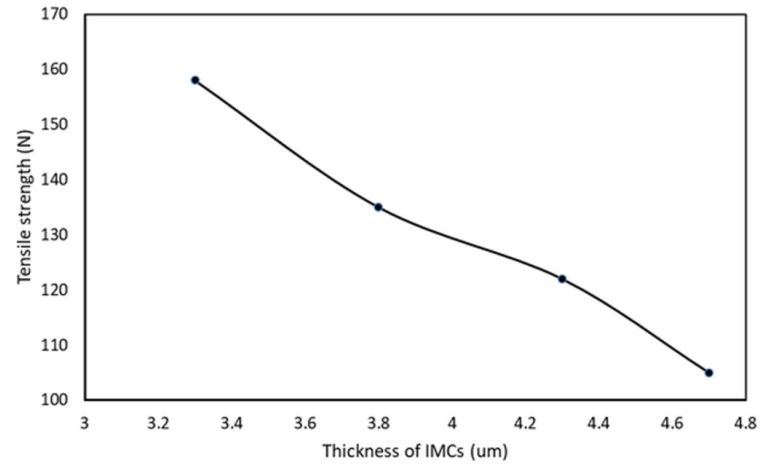
Figure 2: Effect of IMC layer thickness on tensile strength. (Image source: H. He et al.) [1]
To address this issue, a more effective approach is to increase the weld interface area rather than solely relying on greater penetration depth. Expanding the interface area enhances metallurgical bonding while limiting the overall IMC volume. This reduces brittleness and promotes more uniform stress distribution at the joint, thereby improving reliability. This effect can be achieved by combining laser pulses with beam scanning technology to precisely control heat input and interface formation, minimizing IMC growth.
Photon Automation has developed advanced pulse and power controllers capable of microsecond-level precision control over lasers, enabling customized pulse shaping. By fine-tuning the pulse shape, localized thermal stress is reduced, ideal mechanical properties of the material are preserved, the heat-affected zone (HAZ) is minimized, and part lifespan is extended. The company's WonderBOARD also interfaces with galvo mirror controllers, enabling uniform distribution of laser energy across workpieces. This prevents hot spots and uneven heating caused by rapid beam movement.
Laser Pulse and Beam Oscillation Control for IMC Formation
Pulsed lasers offer superior thermal input control, reducing risks of over-melting or spatter. The cooling intervals between pulses minimize heat accumulation, helping prevent defects like burn-through or distortion. For thin-material welding or dissimilar metal joining (e.g., aluminum-to-steel), pulsed technology also enhances melt pool stability.
Dynamic scanning of the laser beam across the weld zone via a galvanometer ensures uniform energy distribution. This prevents edge effects (excessive penetration, undercut, or hot spots caused by prolonged dwell at the start/end of the weld path). Oscillation technology also enables customized weld profiles (e.g., circular, helical, or sawtooth) to enhance joint mechanical strength and uniformity.
The combination of pulsing and oscillation creates a highly controllable welding environment that minimizes thermal gradients, optimizes metallurgical bonding, and ensures more uniform stress distribution. This approach is particularly critical in battery manufacturing, enabling precise energy control to avoid damaging sensitive components or insulated areas.
The second challenge involves achieving precise weld seam positioning and consistent weld quality.
In cylindrical cell designs, both positive and negative electrodes reside on the top surface-the central electrode cap serves as the positive electrode, while the surrounding annular region functions as the negative electrode. This layout restricts the available welding area, demanding extreme precision in laser positioning. Even minor misalignment can result in insufficient weld strength, internal damage, or short circuits, all of which increase cell failure risk and, in severe cases, may trigger thermal runaway.
During assembly, these battery modules typically contain hundreds of closely packed cells. Minor variations in cell height caused by manufacturing tolerances or handling can result in uneven contact between the busbar or welding tool and the cells. If not properly addressed, this inconsistent contact leads to fluctuating weld quality, poor electrical connections, and long-term performance issues.
To overcome these challenges, manufacturers rely on two core systems: vision systems and optical coherence tomography (OCT).
Vision systems detect and locate the positive terminal (center cap) and negative terminal (outer ring/edge) of each cylindrical cell. Additionally, vision systems compensate for cell-to-cell variations/tolerances and fixture alignment deviations, guiding the laser beam to the correct welding position while avoiding contact with insulation layers or edge areas. This enables consistent, high-precision welding across modules containing hundreds of cells.
OCT measures the height of each cell prior to welding to detect the slightest height variations. It dynamically adjusts the laser focus position via an electrically driven collimating lens, ensuring the laser consistently focuses on the precise weld plane. This enhances weld quality and reliability in automated production environments where minor height variations may exist between cells within a battery module.
Welding Process Monitoring and Data Acquisition: The Foundation of AI
Implementing a Laser Welding Monitoring (LWM) system is a critical step toward achieving AI-driven process control. During laser-material interaction, energy is released in multiple forms: plasma radiation (ultraviolet wavelength), thermal radiation (infrared wavelength), back reflection (laser's actual wavelength), and laser power transmitted through optical components. Each of these signals contains valuable information about welding process parameters.
Photodiode-based sensors capture this radiation information in real time and compare it against reference data for high-quality welds. This continuous data acquisition helps identify defects such as lack of fusion, missed welds, or inconsistent penetration depth. Over time, the accumulation of high-resolution process data provides the foundation for training AI models. These models can detect patterns, predict failures, and enable closed-loop optimization of the welding process.
Process Development Validation for Welding Quality
In laser welding of cylindrical lithium-ion batteries, ensuring the integrity of internal welds is critical to safeguarding battery safety and performance. During welding, particular attention must be paid to protecting any plastic or rubber materials beneath the top surface: excessive heat input, improper laser parameters, or excessive penetration depth can damage underlying insulation layers or plastic/rubber structural components, leading to short circuits, leakage, mechanical failure, or thermal runaway.

Figure 3: 3D-CT image showing weld penetration details. (Image source: Photon Automation)
Computed tomography (CT) enables non-destructive, high-resolution inspection of welded joints, providing 2D and 3D data that reveals internal weld defects such as porosity, uneven penetration at the weld interface, or insufficient penetration (see Figure 3). This 3D CT data supports process development by validating weld quality and identifying whether penetration reaches sealing or insulating materials, thereby better preventing such issues during welding.


