


Recently, Prof. Chunping Huang's team at Nanchang University of Aeronautics and Astronautics (NUAA) has conducted a series of studies on the mechanical properties and flame retardancy of Ti40 flame-retardant titanium alloy by LSF technology. The team took typical Ti40 flame retardant titanium alloy as the research object and prepared Ti40 flame retardant titanium alloy by LSF technology. The microstructure, mechanical properties and flame retardant properties of laser stereoforming specimens and conventional forging specimens were investigated, and the flame retardant properties and mechanical properties of the laser stereoforming specimens, which are superior to those of the conventional forging specimens, were also studied and discussed. The related research results were published in the Journal of Manufacturing Processes under the title of "Achieving superior burn resistant and mechanical properties of Ti40 alloy by laser solid forming". of Manufacturing Processes. The paper was authored by M.S. student Ki-Min Huang, and the corresponding authors are Dr. Feng-Gang Liu and Prof. Chun-Ping Huang.

Ti40 (Ti-15V-25Cr) flame-retardant titanium alloy is a new type of highly stable β-titanium alloy with excellent comprehensive mechanical properties and flame-retardant properties, which is widely used in fan compressor components of large engines with high aspect ratios and other structures. However, its poor high-temperature plasticity and fluidity lead to high cost, long cycle time, and low material utilization in conventional machining.
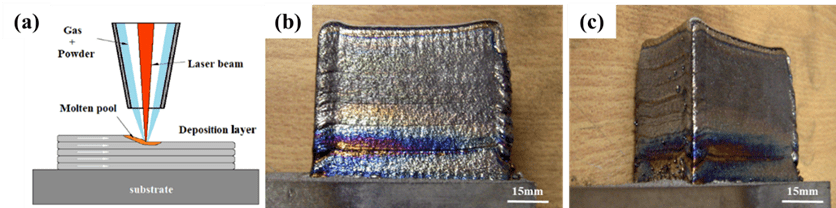
Therefore, there is an urgent need to find a new manufacturing technology to improve these problems. With the development of additive manufacturing technology, laser solid forming (LSF) based on laser cladding and rapid prototyping technology has also been applied on a large scale. It can manufacture parts directly from CAD models, and it can repair damaged parts, which brings new ideas and methods for the processing and manufacturing of flame retardant titanium alloys.
Fig. 1 Schematic diagram of laser stereoforming and LSF block topography:
(a) laser stereoforming; (b) (c) LSF block

Fig. 2 Schematic diagram of LSF block sampling and ablation experimental process:
(a) Block sampling (b) Ablation experimental treatment (c) Ablation specimen sampling

Fig. 3 Schematic diagram of the flame retardation mechanism of Ti40 alloy

Fig. 4 Cross-sectional image of Ti40 alloy:
(A) top region of LSFed sample; (B) middle region of LSFed sample; (C) bottom region of LSFed sample; (D) forged sample;
1=OM; 2=SEM.

Fig. 5 TEM images of the precipitated phases of the LSFed sample: (A) bright field of Ti5Si3; (B) electron diffraction pattern of Ti5Si3.

Fig. 6 Sample surface morphology of Ti40 alloy after ablation:
(a) LSFed; (b) forged state; (1) ablated 3 S; (2) ablated 4 S; (3) ablated 5 S.

Fig. 7 Laser ablation pit model images: (a) ablation pit model; (b) measurement points

Fig. 8 SEM images of ablation pits: (a) surface topography of LSFed ablation pit; (b) surface topography of ablation pit of forged specimen; (c) bottom topography of LSFed ablation pit; (d) bottom topography of ablation pit of forged specimen; (e) side wall topography of LSFed ablation pit; (f) side wall topography of ablation pit of forged specimen

Fig. 9 SEM images of the cross-section of the ablation pit: (a) LSFed specimen ablation pit; (b) bottom of the ablation pit of LSFed specimen; (c) ablation pit of forged specimen; (d) bottom of the ablation pit of forged specimen

Fig. 10 SEM images of the fracture of LSFed Ti40 alloy: (a) macroscopic morphology of the specimen fracture; (b) enlarged morphology of area A; (c) enlarged morphology of area B
Based on the above study, the LSF process improves the problems of high processing cost, long cycle time, and low material utilization brought by the traditional machining of Ti40, and the Ti40 alloy prepared by laser stereoforming technology has more excellent mechanical properties compared with the forging parts, and at the same time, due to the special tempering effect in the process of laser stereoforming, the β-phase in the Ti40 alloy precipitates a high melting point of Ti5Si3, which can not only improve the oxidation efficiency of V and Cr elements by retaining the pores, but also slow down the flaking of the oxide layer by strengthening the bonding between the matrix and the oxide layer and improve the flame retardant property of Ti40. The study of mechanical properties and flame retardant properties of Ti40 alloy prepared by LSF technology provides a new technical means for realizing high-performance, rapid and low-cost preparation of flame retardant titanium alloy complex structural parts.


