


In H1 2026, China's photonics industry formed a complete closed-loop industrial chain featuring mass domestic production of upstream laser chips, miniaturized iteration of midstream laser devices, and downstream replacement and implementation of diversified industrial processes. Driven by green manufacturing policies and capacity expansion in the new energy sector, laser technology has broken free from its traditional role only in metal cutting. Four high-growth application directions have taken shape: eco-friendly laser cleaning, UV precision micro-processing, closed-loop AI lithium battery welding, and laser modification for photovoltaic cells.
China's overall laser equipment market size exceeded 95.8 billion RMB in 2025, accounting for 58% of the global market share. In the first half of 2026, the industry's total revenue rose by 21.3% year-on-year, with equipment orders from the new energy industry ranking first in growth rate across all sectors.
In H1 2026, China's photonics industry formed a complete closed-loop industrial chain featuring mass domestic production of upstream laser chips, miniaturized iteration of midstream laser devices, and downstream replacement and implementation of diversified industrial processes. Driven by green manufacturing policies and capacity expansion in the new energy sector, laser technology has broken free from its traditional role only in metal cutting. Four high-growth application directions have taken shape: eco-friendly laser cleaning, UV precision micro-processing, closed-loop AI lithium battery welding, and laser modification for photovoltaic cells.
China's overall laser equipment market size exceeded 95.8 billion RMB in 2025, accounting for 58% of the global market share. In the first half of 2026, the industry's total revenue rose by 21.3% year-on-year, with equipment orders from the new energy industry ranking first in growth rate across all sectors.

At Laser World of Photonics China 2026, held in March, mainstream domestic laser source enterprises launched their new-generation products in a centralized manner. Multiple compact air-cooled MOPA pulsed laser sources specially optimized for laser cleaning achieved mass production. Their overall volume is 40% smaller than equivalent imported products, supporting dynamic adjustment of power and pulse width during operation with microsecond-level signal response speed.
These lightweight pulsed laser sources can be integrated into trolley-style all-in-one cleaning machines for on-site mold refurbishment, rust removal and paint stripping on large-scale structural components. They are also applied to tasks such as blue film peeling on lithium battery cells and precise edge trimming of photovoltaic silicon wafers, enabling a single laser source to handle both light-duty and heavy-duty precision working conditions.
Meanwhile, 300W nanosecond UV lasers and 3000W green disk lasers made their debut at the show, tackling long-standing challenges in welding highly reflective metals such as copper and aluminum, and filling gaps that previously relied on imported equipment in thermal module assembly and superconducting material fabrication. In addition, the world's first 5000W air-cooled single-mode fiber laser was officially released, ending the industry's convention that high-power lasers must be equipped with bulky water cooling units. This innovation makes laser equipment applicable to outdoor mobile scenarios including vehicle-mounted and airborne maintenance.
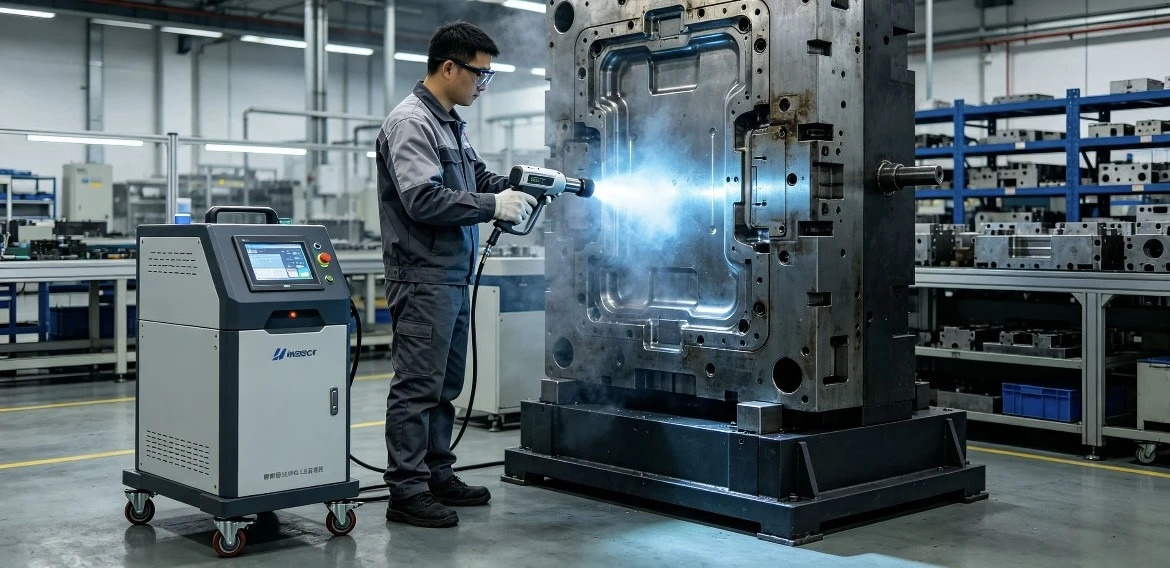
In mass production workshops for power batteries, closed-loop laser welding systems embedded with AI diagnostic algorithms have widely replaced traditional spot welding processes. During tab welding, sealing nail encapsulation, and PACK busbar welding, these integrated systems identify weld defects in real time, lifting the yield rate of lithium battery welding up to 99.97%.
Matching intelligent pulsed laser cleaning technology enables injection molds to be cleaned of oil stains and carbon deposits directly on production stations without being taken offline and disassembled. This reduces equipment downtime for lithium battery factories by more than 50%, while eliminating hazardous waste risks caused by chemical soaking cleaning.
The photovoltaic industry has become the second major growth engine for laser technology. With the popularization of next-generation high-efficiency TOPCon and BC (Back Contact) solar cells, laser edge isolation and laser selective doping have become standard procedures to boost cell efficiency. Picosecond laser precision etching remodels the surface structure of silicon wafers to reduce charge recombination loss inside cells, lifting the output power of a single photovoltaic module by more than 0.76%.
Leading domestic photovoltaic enterprises have completed full replacement of imported laser equipment with domestic alternatives, cutting overall comprehensive operating costs by 60%. Even amid capacity adjustments across the photovoltaic industry in H1 2026, stable demand persisted for laser process equipment used in upgrading and retrofitting solar cell production lines.

Upstream domestic independent technological breakthroughs lay the foundation for this industrial upgrade. Domestic 6-inch GaAs laser chip production lines are running at full capacity, and kilowatt-level blue semiconductor laser chips have achieved bulk supply, breaking long-term overseas monopolies in laser sources for highly reflective metal welding.
Many photonics chip enterprises announced large-scale fixed-income fundraising plans for capacity expansion, focusing on research of continuous wave pump chips and ultrafast laser chips. The declining manufacturing cost of domestic complete machines has pushed lightweight pulsed cleaning machines and desktop UV precision marking machines to penetrate further into small & medium hardware processing, auto parts maintenance, daily chemical packaging and other traditional industries.
Industry analysts summarized two clear development trends for domestic laser applications in H2 2026:
First, the widespread adoption of AI adaptive algorithms. Laser cleaning and welding equipment can automatically identify contamination thickness and workpiece material, and match optimal laser parameters with one click.
Second, further air-cooling and miniaturization of equipment to expand outdoor on-site maintenance scenarios. Against the backdrop of industrial green retrofits and global new energy capacity expansion, domestic integrated laser solutions will continue to accelerate the phase-out of high-pollution traditional processes including acid pickling, sandblasting and manual grinding.
Picture Arrangement Instructions


