


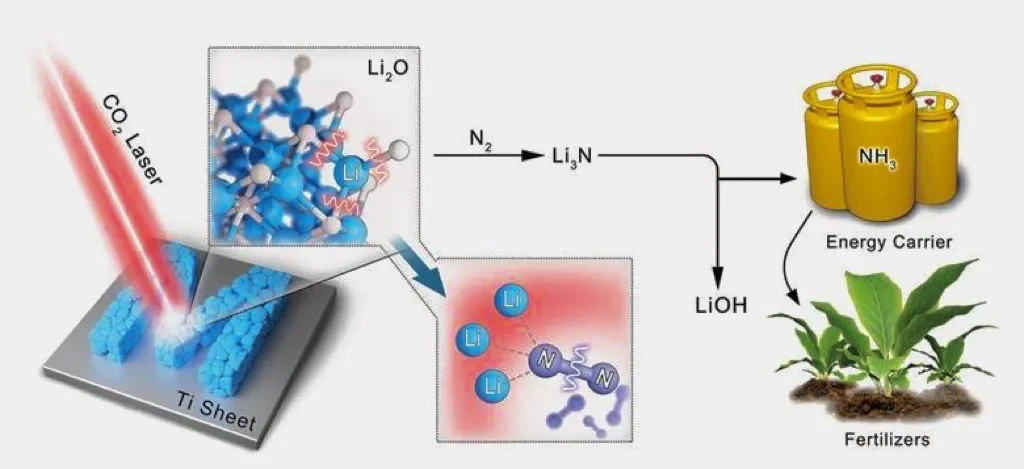
The use of laser technology has revolutionized the method of nitrogen fixation, providing a new way to synthesize ammonia under ambient conditions. Recently, researchers used a commercial CO2 laser for the first time to disrupt the nitrogen-nitrogen triple bond, thus providing a new green alternative to the Haber-Bosch process.
The international research team reportedly used a laser to convert lithium oxide into lithium metal, which then spontaneously reacted with nitrogen in the air to form lithium nitride. This salt is easily hydrolyzed to ammonia, allowing the method to break record yields.
Huize Wang, first author from the Helmholtz Institute for Renewable Energy in Germany, said, "We introduced a pioneering concept that uses high-energy lasers to facilitate the conversion of various oxides into nitrides."
He added, "We achieved unprecedented yields at room temperature and atmospheric pressure. This result is remarkable compared to other methods." The actual yield is two orders of magnitude higher than other state-of-the-art solutions, including electrochemical and mechanochemical methods.
This is a completely new approach to producing green ammonia, which is potentially more sustainable than the Haber-Bosch process," said Victor Mougel, an expert in electrochemical conversion of small molecules at the Swiss Federal Institute of Technology in Zurich, Switzerland. "The Haber -Bosch process is very energy-intensive due to the fact that it operates at high temperatures and pressures, and it also leads to CO2 emissions."
In addition, he said, the new method "offers operational flexibility and environmental benefits" because it works under ambient conditions. The process can also produce ammonia directly where it is needed, which reduces transportation costs.
The team used an infrared laser to provide enough energy to dissociate the lithium-oxygen bond to produce lithium metal from lithium oxide. When exposed to air, lithium metal spontaneously combines with nitrogen, breaking the nitrogen-nitrogen triple covalent bond to produce lithium nitride.
He further explains, "Next, we get ammonia and lithium hydroxide by hydrolyzing the laser-generated lithium nitride. In addition, this method provides opportunities for chemical recycling. The laser can induce the conversion of lithium hydroxide back to lithium nitride, effectively ending the lithium cycle."
He added: "This simultaneously becomes another new concept - the conversion of hydroxide to nitride."
However, Ifan Stephens, an electrochemistry and nitrogen fixation expert at Imperial College London (UK), remains skeptical. He says: "I am skeptical that such high yields will be sustainable in the long term. In addition, the fact that it is a batch process, rather than a continuous process, will greatly limit its feasibility. The fact that electrochemical techniques allow for continuous operation is a significant advantage over newer laser-induced methods."
In addition, the energy requirements of lasers could pose a problem for scaling up ammonia synthesis. He added: "If you are only producing ammonia on a small scale as a fertilizer in remote areas, then energy efficiency becomes less important."
The researchers suggest that their method offers significant advantages over electrochemistry, such as desolvation and simplification. In addition, all emerging ammonia synthesis methods face their greatest challenges as production scales up. The researchers envision scaling up the process by distributing lithium oxide powder on a lattice surface and then irradiating the array of reactive cells one by one with a laser. In addition, the researchers observed that other oxides exhibited similar behavior, such as magnesium, aluminum, zinc and calcium, albeit in lower yields.
He explains, "This may be because other oxides are more difficult to dissociate and hydrolyze." However, the reactivity of alkaline and alkaline earth metals toward nitrogen seems promising. He states, "Our recent research shows that more abundant metals such as magnesium and calcium can also break down nitrogen."


