


As an emerging metal processing technology, laser welding technology can achieve welding processing of various metal materials and has a wide range of applications in the metal processing industry. Laser welding technology gathers a high energy density laser beam through the laser reaction principle, which is characterised by high speed and accuracy and has been used more often in precision metal processing companies. In order to speed up the innovative development of commercial air conditioners, GREE has introduced laser welding to provide a new way of processing and manufacturing sheet metal parts for commercial air conditioners and to further enhance the competitiveness of product quality.
Background to the application of laser welding
The air conditioning industry currently uses gas shielded welding, arc welding, reaction welding and other welding methods to achieve a sealed combination of sheet metal parts. However, due to the above welding methods have energy output dispersion, diffusion and other characteristics, there are generally poor weld quality, personnel labour intensity, poor operating environment and other problems, and accompanied by welding spatter, the need to go through the post-process grinding flat, resulting in continuous welding costs increase, is not conducive to the long-term development of enterprises and technological innovation.
Experimental study of laser welding
The GREE laser welding pilot study started with electric control box type parts with the aim of replacing the traditional CO2 gas shielded welding by the application of laser welding. The raw material for the electric control box parts is hot-dip galvanised sheet, generally between 1.0 and 3.0mm thick, mainly taking into account the more regular shape of this type of electric control box parts, the weld seam is spatially straight distribution state, its three-dimensional view is shown in the figure. Excessive weld depths can lead to parts being welded through, adding additional operations such as secondary filler welding, and the quality of filler welding is extremely demanding when gas-tight, water-sealed parts are involved. If the depth of the weld is too small, the weld height may be too high, increasing the amount of work required for post-process grinding. Therefore, for the relationship between weld depth and welding speed, laser power, in the experimental research is often used to control the variable method, in different power of laser welding, the relationship between weld depth and welding speed is shown in the figure below.

Practical applications of laser welding
Applications in commercial water tray components
As a key part of the commercial water-cooled unit, the welded sealing of the water tray parts is particularly important. These parts are mainly used for the collection of circulating wastewater from the water-cooled unit, the shell is subjected to high water pressure and needs to meet the requirements of corrosion resistance.
Compared to traditional carbon steel materials, stainless steel materials have high resistivity and high coefficient of thermal expansion, combined with the material's welding metallurgical characteristics, the current manufacturing of commercial water pan parts mostly use resistance spot welding process plus arc welding process mode.However, there are certain problems and shortcomings, mainly: although resistance spot welding can effectively reduce the welding deformation of the water tray parts, there are obvious indentation marks at the welded joints, and the number of welded joints is high, which affects the quality consistency of the parts and increases the workload of the later grinding process.And resistance spot welding is a discrete and independent form of point connection, spot welding process of the water catch pan parts structure sealing is poor.Although manual arc welding can achieve continuous seal welding, as shown below, but stainless steel arc welding deformation, a large number of arc welding will cause thermal deformation of the water receiving plate parts, affecting the position of the lowest point of the entire part, resulting in a long time storage of water in the parts, is not conducive to the long-term stable operation of water-cooled units.

The use of laser welding on the bending edge of the residual seam requirements are high, generally 1500W laser requires a weld width of 2.5 mm or less. If the weld is too wide, there may be weld penetration, empty welds and deformation, and the parallelism of the entire weld is required to be maintained in a generally consistent manner.Otherwise there will be unstable wire filling, resulting in a small gap in a section of the welding height is large, the middle section just to meet the requirements, while the gap between the large end of the empty weld, seriously affecting the quality of the parts, the secondary filler welding needs to be carried out manually, but reduce the production efficiency.
Laser welding also facilitates the reduction or elimination of post-process grinding workload. With the right welding parameter settings, it is possible to reduce the welding height and even achieve a flatness of 0.1mm, which is a boon for stainless steel grinding.As the hardness and strength of 304 stainless steel is more than 5 times that of ordinary galvanised sheet metal, the amount of grinding discs consumed and the amount of work involved is considerably higher.Grinding a weld height of 1.2mm, length of 100mm stainless steel weld requires an average of 5min, continuous grinding work not only increases the operator's labour intensity, but also increases the production cost of the product, which is not optimistic for the development of enterprises. Stainless steel parts are manually polished after welding as shown below.

In order to change the existing process, through communication and cooperation with advanced laser equipment manufacturers at home and abroad, we have developed a six-axis industrial robot, automatic laser welding gun and wire feeding control system, flexible fixture workbench integrated with programmable demonstration and teaching laser automatic welding solution.The solution enables the rapid clamping and positioning of different series of parts by designing flexible fixtures to synchronise the rapid changeover of parts.The welding path is taught by means of a hand-held robot end torch, thus making automated welding operations significantly less difficult and reducing the input of specialist welding operators.
The current use of six-axis robot laser welding system to weld the water tray parts, as shown in the figure, the welding power of 1500W, the average welding speed of 1.4m/min, the entire clamping and positioning costs 5min, manual teaching and programming costs 10min, welding process 2min, other adjustments took 8min, the initial welding of a single water tray parts took 25min, as a result of welding again this kind of As no teaching and other adjustments are required to weld the part again, the average time spent on a single water tray part is 7 min in mass production, and no grinding is required for the post-process, no specialist welding operators are required, and the process costs are reduced by more than 25%.

Applications in commercial support frame components
As the skeleton of the commercial external machine structure, there is a large amount of support frame parts, which are designed in a long box-like structure to facilitate assembly and load-bearing.As this type of part mainly plays the role of frame support inside the box, it is not in direct contact with the external environment and therefore does not have high requirements for corrosion resistance.The galvanised layer of galvanised sheet not only provides physical shielding but also electrochemical protection to the steel substrate, making it a cost-effective steel material.
The galvanised layer of galvanised sheet not only provides physical shielding but also electrochemical protection to the steel substrate, making it a cost-effective steel material.The reason for this is the great difference in the physical properties of the zinc coating and the base carbon steel during the welding of the galvanised steel sheet (the zinc coating has a melting point of 420°C and a boiling point of 908°C, whereas the base steel has a melting point of 1300°C and a boiling point of 2861°C).The vapourisation of the zinc coating therefore precedes the melting of the base steel, a phenomenon which can have a significant impact on the welding process and the quality of the galvanised steel sheet.
Currently, the three main welding processes for support frame parts are resistance spot welding, electric arc welding and laser welding.For resistance spot welding, the presence of a galvanised layer makes the electrode susceptible to alloying with the zinc layer during welding, which accelerates the oxidation process on the surface of the copper electrode and requires the operator to continuously polish the electrode tip, thus reducing the service life of the copper electrode.When manual arc welding is used, due to the low boiling point of zinc, when the arc first touches the galvanised layer, the zinc rapidly vaporises and the resulting zinc vapour is ejected outwards, which can easily cause welding to produce slag particles, porosity and spatter, resulting in large differences in the flatness of the weld surface, increasing the workload of post-process grinding and a major quality hazard for parts that need to be gas-tight and waterproof, as shown in the diagram below.There is a more obvious phenomenon of volatilisation of the zinc layer in the weld of the parts welded by manual arc welding, especially near the middle and rear end where there is a larger pool of molten spray, leading to the appearance of quality problems such as weld tumours and porosity.
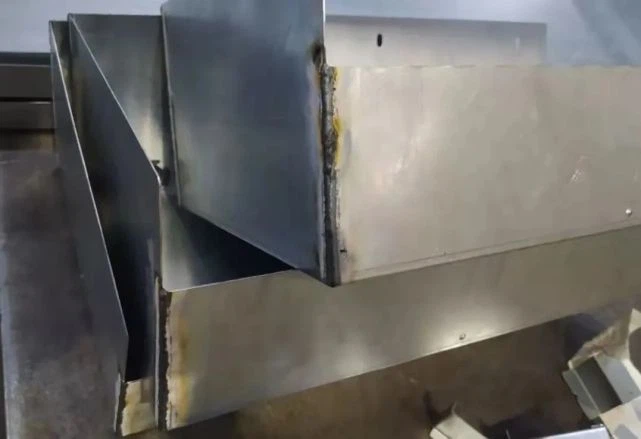
The application of laser welding not only improves the strength and stiffness of the weld seam, but also solves the problems of traditional resistance spot welding in welding galvanised steel sheets and high-strength steel sheets, such as large welding deformation, low weld joint flatness, easy to produce gaps and reduced strength of the base material.Commercial support frame parts in the use of laser welding process, because the laser can be a large energy density in a small gap under the penetration of the weld, so that the weld form for intermittent welding, from the mechanical properties of the test data, the use of laser welding after the strength of the weld can be about 30% higher than resistance spot welding, as shown in the figure below.


